

PD 3.1 vs PD 3.2: The Essential Guide to Choosing the Right USB-C Power Spec
Published: September 2026
Reading time: 12 min
Audience: Procurement leads, brand owners and hardware startups deciding between PD 3.1 vs PD 3.2 chargers and power supplies — and anyone who needs to know whether EPR or SPR AVS actually matters for their SKU before they brief a factory.
By Han — Paiyi Power, a Huizhou-based OEM/ODM building custom GaN chargers and power supplies from 65W to 140W, designed to the USB PD 3.2 specification (with SPR AVS) at MOQ 200 pcs per model.
Last updated: 28 September 2026.
Contents
Direct answer: PD 3.1 vs PD 3.2, which should you choose?
For most new USB-C products the right call is to design to USB PD 3.2 with SPR AVS, because it is a superset of PD 3.1’s EPR capability with smoother voltage control that protects both charger and load. If your device draws up to 140W (28V/5A), PD 3.1 EPR already covers you and a PD 3.2 build will still serve it. Choose PD 3.2 when you want finer-grained voltage steps, better light-load behaviour, or a cleaner path to future 240W EPR cabling. The PD 3.1 vs PD 3.2 decision is rarely about raw wattage — it is about how precisely and safely you want to govern the rail. Pick the newer spec unless a legacy cert locks you to 3.1.
What actually changed between PD 3.1 and PD 3.2
USB Power Delivery 3.1 was the version that broke the old 100W ceiling by introducing Extended Power Range (EPR): it raised single-port output to 28V/5A, or 140W, and opened the door to 36V and 48V profiles for up to 240W. PD 3.2 keeps EPR intact and adds SPR AVS (Adjustable Voltage Supply) inside the Standard Power Range, letting the source step voltage in small increments instead of the old fixed 5/9/15/20V ladder. In practice the PD 3.1 vs PD 3.2 gap is not “more power” — 3.2 does not raise the 140W ceiling — but “more control.” That control is what lets a charger hold a battery or a motor at its ideal voltage without bouncing between coarse steps.

The second change buyers care about is maturity of the ecosystem. When PD 3.1 launched, EPR cables and sinks were scarce and the 28V rail was treated as exotic. By the PD 3.2 era, 140W chargers are commodity enough that firmware quality — not the spec number — separates a good unit from a risky one. So the honest framing for a procurement lead is: PD 3.1 got us to 140W, PD 3.2 made that power governable. You are almost always better served by a factory that targets 3.2 while remaining fully backward-compatible with 3.1 sinks. The PD 3.1 vs PD 3.2 decision for most teams ends here: pick the newer spec unless a legacy cert blocks it.
EPR explained: the 28V/5A ceiling and 140W
EPR is the PD 3.1 feature that matters most for high-wattage products. It lifts the max from 20V/5A (100W) to 28V/5A (140W), defining 36V/48V rails to 240W with the right EPR cable. For a laptop or docking brick, EPR lets one USB-C port replace a barrel jack. The cable catch: above 100W it needs a certified 240W EPR cable with an e-marker, and the source negotiates the higher voltage only after confirming the cable can carry it. A PD 3.1 vs PD 3.2 charger that supports EPR must therefore refuse to ramp voltage on a legacy 100W cable. In the PD 3.1 vs PD 3.2 comparison, EPR is the part that already shipped; AVS is what makes it governable.
What this means for sourcing: ask the factory which EPR profiles their firmware actually offers, and whether the 28V rail is supervised by a real secondary-side controller rather than a token IC. A charger that claims “140W EPR” but cannot prove negotiation safety on a mismatched cable is a liability. EPR is the headline capability; the unglamorous part — safe negotiation — is where field failures are born. Treat the cable handshake as a design requirement, not a footnote. The PD 3.1 vs PD 3.2 gap shows up most at this negotiation step.
AVS explained: SPR AVS and finer voltage steps
SPR AVS is the defining PD 3.2 addition, inside the Standard Power Range (up to 20V). Where older PD jumped between 5V, 9V, 15V and 20V, AVS lets the source offer a continuous-ish band — 15V to 20V in 200mV steps — so the load sits at the exact voltage it wants. For a battery that charges at 17.4V, or a motor at 16.2V, AVS removes the waste of a fixed rung. The PD 3.1 vs PD 3.2 difference here is efficiency and thermal: less conversion loss means less heat, and less heat means a smaller enclosure survives. For PD 3.1 vs PD 3.2 buyers, AVS is the quieter win — no extra watts, just less waste.
AVS also helps light-load regulation. Cheap fixed-step supplies droop or chatter near zero load; an AVS source holds a clean rail. For products that spend most of their life trickle-charging or idling — sensors, wearables docks, IoT gateways — this is where PD 3.2 earns its keep even though the peak wattage never approaches 140W. When you brief a factory, name AVS explicitly; “supports PD 3.2” is sometimes used loosely, and you want the adjustable band in writing, not assumed. The PD 3.1 vs PD 3.2 choice for these low-load products is essentially an AVS choice.
PD 3.1 vs PD 3.2: the spec comparison table
Use this table as the single reference when your engineering team argues about which spec to brief. The headline is that PD 3.2 does not increase the 140W ceiling — it refines how the power is delivered. The practical winner for a new design is almost always PD 3.2, because it is backward-compatible with every PD 3.1 sink while adding AVS control you may want later.
| Dimension | USB PD 3.1 | USB PD 3.2 |
|---|---|---|
| Max single-port (EPR) | 140W (28V/5A), up to 240W defined | Same 140W ceiling; 240W EPR retained |
| SPR voltage steps | Fixed 5/9/15/20V ladder | Fixed ladder + AVS band (≈15–20V, 200mV steps) |
| Light-load regulation | Coarser; may chatter near zero | Cleaner rail via AVS |
| Backward compatibility | Works with all older PD sinks | Works with all older PD sinks (superset) |
| Cable requirement (EPR) | Certified 240W EPR e-marked cable | Same certified EPR cable requirement |
| Best for | Legacy 140W programs already certified | New designs wanting efficiency + future 240W path |
Which PD revision does your product actually need?
Not every product benefits from PD 3.2, and over-specifying wastes money. Match the spec to the load profile, not to the marketing number. The table below gives a default recommendation by product type; treat it as a starting point for the conversation with your factory, not a rule carved in stone. The PD 3.1 vs PD 3.2 debate is really about load profile, not peak watts.
| Product type | Peak need | Recommended spec |
|---|---|---|
| 20W phone / earbud charger | <20W, fixed steps fine | PD 3.1 (legacy) is sufficient |
| 65W laptop GaN brick | 20V/3.25A, no EPR | PD 3.2 with AVS for efficiency |
| 140W laptop / dock | 28V/5A EPR | PD 3.2, EPR-capable (covers 3.1) |
| Battery / motor at 16–18V | Precise mid-band voltage | PD 3.2 AVS strongly preferred |
| Future 240W device | 48V EPR planned | PD 3.2 + certified EPR cable path |
Certification reality: designed-to-spec vs USB-IF TID
The single most confused point in any PD 3.1 vs PD 3.2 discussion is certification. “Designed to USB PD 3.2 specification (with SPR AVS)” means the firmware and hardware follow the spec — it does not mean the product carries a USB-IF certification with a TID number. Most chargers on the market are designed-to-spec, not USB-IF-certified, and that is normal and acceptable for OEM programs. Reserve the phrase “USB-IF certified” only for a supplier who can show a valid TID. A factory that blurts “PD 3.2 certified” without a TID is either sloppy or overselling; ask for the certificate PDF, not the badge.
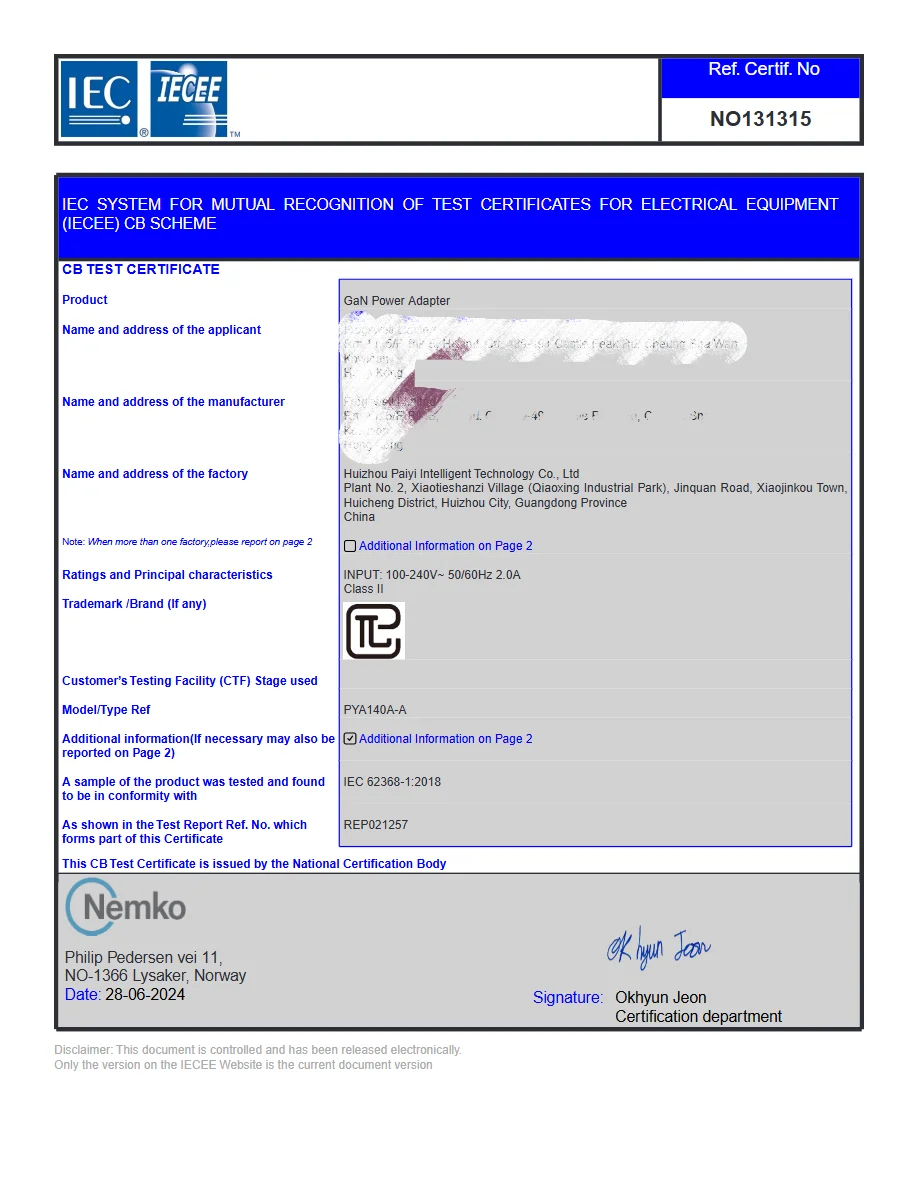
The marks that do matter for customs and retail are the regional safety certificates: CE, CB (IECEE), FCC, RoHS and ErP. These are the certificates a competent OEM holds as standard. USB-IF compliance is a protocol-layer detail most B2B buyers accept as designed-to-spec. So when you write the spec sheet, say “designed to USB PD 3.2 (with SPR AVS)” and list the safety certs you actually hold — that is accurate, defensible, and what auditors want to see.
The firmware and protocol-stack questions to ask
A PD charger is mostly firmware wearing a heatsink. The PD 3.1 vs PD 3.2 choice lives in the protocol stack: how the source negotiates PDOs, how it enters AVS, and how it backs out safely when the sink misbehaves. When you vet a factory, ask to see the PDO table they program, the AVS entry/exit logic, and their handling of a sink that requests a voltage the cable cannot support. A supplier who lights up at these questions owns the stack; one who redirects to price bought a turnkey module they cannot tune. Stack ownership is what lets them fix a negotiation bug in days instead of months.
Also ask about over-voltage and over-current supervision on the secondary side. The controller should shut the rail down on a fault, not just flag it. Request the test where they force a bad cable or a shorted sink and show the charger protecting itself and the load. This is the difference between a PD 3.2 charger that is safe by design and one that is safe by luck. Write the fault-response requirement into the RFQ so it is measurable, not a courtesy. The PD 3.1 vs PD 3.2 firmware gap is widest exactly at this fault-response step.
Safety supervision at 28V: what protects the rail
EPR’s 28V rail is double the classic 20V, and at 5A the energy available in a fault is real. The PD 3.1 vs PD 3.2 conversation must include how the charger supervises that rail. Requirements: a secondary-side supervisor that monitors voltage and current independently of the primary controller, proper creepage and clearance on the PCB, and an e-marker check that refuses to raise voltage on an uncertified cable. A genuine PD 3.2 OEM shows you the supervisor IC, the clearance calculation, and the negotiation log that proves the cable was validated before the rail ramped.

Ask for the IEC 62368-1 compliance approach by name. That is the safety standard that governs this class of equipment, and a factory serious about EPR knows it cold. If the answer is vague, the rail supervision probably is too. Safe negotiation is not a feature you add later; it is designed in from the first schematic, and it is the part of PD 3.2 you should never compromise to hit a price point. A PD 3.1 vs PD 3.2 charger that skips this step fails the same way regardless of spec number.
Thermal budget: smaller charger, tighter margin
Both PD 3.1 and PD 3.2 push more watts through a smaller GaN brick, so thermal margin is where chargers live or die. At 140W the case can sit near its limit under sustained load, and AVS does not remove that — it just lets the converter run more efficiently so less heat is generated. When you compare PD 3.1 vs PD 3.2 for a pocket-sized 140W charger, ask for the documented case-temperature curve under sustained max draw and the derating behaviour when one port is loaded. A supplier who only shows a golden-sample number is hiding the thermal truth.

Thermal design is engineering, not luck. Probe who ran the simulation, where the hot spots are, and how the enclosure vents without sacrificing the compact form factor that justified GaN in the first place. A smaller charger that throttles after five minutes defeats the purpose. Tie the thermal acceptance criteria to the pilot run (below), and reject the design if sustained load pushes the case past the agreed limit. The PD 3.1 vs PD 3.2 thermal margin question is the same physics; only the control differs.
Cables and the EPR / 240W ecosystem
No EPR charger ships in a vacuum — it ships with a cable, and the cable is the weak link. A PD 3.1 vs PD 3.2 charger that supports 140W EPR is useless without a certified 240W EPR cable carrying a proper e-marker; on a legacy 100W cable the source must stay at 20V/5A. When you source, decide whether the cable is part of your BOM or the customer’s problem. If you bundle it, specify the e-marked 240W cable explicitly and test the negotiation end-to-end, because a cheap cable that lies about its rating is a fire and a return.
The 240W ecosystem is still maturing, so for a product that may climb to 48V later, design the connector and cable path now even if you ship 140W today. PD 3.2 keeps that door open; PD 3.1 does too, but the newer firmware conventions make the 240W handshake cleaner. Either way, treat the cable as a certified component with its own compliance paperwork — not a commodity you grab from a drawer. The cable is part of your safety story. A PD 3.1 vs PD 3.2 charger lives or dies by this cable discipline.
What to ask a PD 3.2 charger OEM
Turn the analysis above into a short audit you run on every factory. The table summarises the questions that separate a PD 3.2 partner from a reseller who printed “PD 3.2” on a brochure. Score each; anything vague is a flag. The PD 3.1 vs PD 3.2 audit below is the fastest way to tell them apart.
| Question | Good answer |
|---|---|
| Which PD revision does firmware target? | PD 3.2, AVS band named in writing |
| EPR profiles offered? | 28V/5A (140W), cable-checked |
| Secondary-side supervisor present? | Yes, independent OV/OC shutoff |
| Safety certs held? | CE/CB/FCC/RoHS/ErP current |
| USB-IF TID or designed-to-spec? | Honest: designed-to-spec, no false claim |
| Thermal margin documented? | Case-temp curve under sustained load |
How Paiyi Power builds PD 3.2 chargers
For transparency, here is how we handle the PD 3.1 vs PD 3.2 question on real programs. Paiyi Power is a Huizhou-based OEM/ODM (founded Shenzhen 2015, Huizhou plant 2019, ~50 people) building custom and modified-standard GaN chargers from 65W to 140W. We design our PD 3.2 firmware in-house — including SPR AVS — while remaining fully backward-compatible with PD 3.1 sinks, and we hold CE, CB, FCC, RoHS, ErP and ISO 9001 for the relevant watt classes. Our 140W units are designed to the USB PD 3.2 specification (with SPR AVS), never claimed as USB-IF certified without a TID we can show.
SMT runs at the Tier-1 factory we hold a stake in (Fuji NXT / M3S lines); the board returns to Huizhou for incoming inspection, manual assembly, 100% ATE and burn-in. UL/ETL/UKCA are buyer-funded and factory-supported, MOQ starts at 200 pcs per model, and lead time is a realistic 5–6 weeks. We document the 28V rail supervision and the sustained-load thermal curve for every EPR program, because those are the details that decide whether your PD 3.2 charger is safe by design or by luck. On every PD 3.1 vs PD 3.2 program we treat rail supervision as the non-negotiable.
Frequently asked questions
These are the PD 3.1 vs PD 3.2 questions buyers ask most, answered without the marketing gloss.
Is PD 3.2 just a newer, more powerful version of PD 3.1?
Not more powerful in peak watts. PD 3.2 keeps the same 140W EPR ceiling that PD 3.1 introduced and adds SPR AVS, which lets the source step voltage in fine increments inside the standard range. So PD 3.2 is better at governing power, not at delivering more of it. For a new design the newer spec is usually the right choice because it remains backward-compatible with every PD 3.1 sink while giving you AVS control you may want later. The PD 3.1 vs PD 3.2 gap is about control, not watts.
Do I need USB-IF certification to sell a PD 3.2 charger?
In most B2B OEM programs, no. The common and acceptable position is “designed to USB PD 3.2 specification (with SPR AVS)” without a USB-IF TID. What customs and retailers check are the regional safety marks — CE, CB, FCC, RoHS, ErP. Reserve “USB-IF certified” only for a supplier who shows a valid TID number, and treat any unbacked “certified” claim as a red flag worth questioning.
EPR vs AVS: what changes in PD 3.1 vs PD 3.2?
EPR (Extended Power Range) is the PD 3.1 feature that raised the ceiling to 140W at 28V/5A and defined up to 240W. AVS (Adjustable Voltage Supply) is the PD 3.2 feature that adds fine voltage steps within the standard range, roughly 15V to 20V in 200mV increments. EPR is about how much power; AVS is about how precisely that power is delivered. A complete PD 3.2 charger supports both, with AVS improving efficiency on mid-band loads. In the PD 3.1 vs PD 3.2 framing, EPR is the ceiling and AVS is the control.
Can a PD 3.2 charger power my existing PD 3.1 laptop (PD 3.1 vs PD 3.2)?
Yes. PD 3.2 is a superset of PD 3.1, so a PD 3.2 source negotiates normally with a PD 3.1 sink and delivers whatever the laptop requests, including 100W at 20V/5A. The AVS band is simply ignored by a sink that does not support it. Backward compatibility is built into the spec, so upgrading your charger firmware to 3.2 does not strand older devices — it only adds capability they do not use. The PD 3.1 vs PD 3.2 backward compatibility is designed in, not bolted on.
Why does my PD 3.1 vs PD 3.2 140W charger need a special cable?
EPR above 100W requires a certified 240W EPR cable with a proper e-marker chip. The source reads the cable’s rating during negotiation and refuses to raise voltage beyond what the cable can safely carry. On a legacy 100W cable, a PD 3.1 or PD 3.2 charger must stay at 20V/5A. Bundling and testing the correct e-marked cable is part of a safe EPR program, not an optional accessory.
Is PD 3.2 better for small chargers under 100W (PD 3.1 vs PD 3.2)?
Often yes, because AVS improves light-load regulation and conversion efficiency, which means less heat in a compact GaN brick. A 65W laptop charger that holds a clean 17V rail via AVS runs cooler than one forced onto the nearest fixed 20V rung. If your product spends most of its life at partial load, PD 3.2’s finer control earns its keep even though peak wattage never approaches the 140W EPR ceiling.
What safety standard applies to PD 3.2 chargers?
The governing safety standard for this class of equipment is IEC 62368-1, covering audio, video, information and communication technology equipment. A serious PD 3.2 OEM designs the 28V rail with an independent secondary-side supervisor, proper creepage and clearance, and a cable check before ramping voltage. Ask for the IEC 62368-1 compliance approach by name; a vague answer usually means the rail supervision is equally vague.
Should I brief the factory for PD 3.1 or PD 3.2?
Brief for PD 3.2 unless a legacy certification already locks you to PD 3.1. PD 3.2 covers every PD 3.1 use case and adds AVS, so you lose nothing and gain a cleaner efficiency and future-240W path. The only reason to stay on 3.1 is an existing certified program you do not want to re-qualify. State the target revision, the EPR profiles, and the AVS band explicitly in the RFQ so the factory cannot substitute a looser build. The PD 3.1 vs PD 3.2 brief should name the target revision in writing.
How do I verify a factory actually supports PD 3.2 AVS?
Ask for the programmed PDO table and the AVS entry/exit logic in writing, then request a negotiation log showing the source stepping through the AVS band with a compliant sink. A factory that owns the firmware provides this without hesitation; one that bought a turnkey module stalls. Pair that with the thermal curve and the 28V rail supervision evidence, and you have a measurable PD 3.2 qualification rather than a badge on a brochure.
Sources
- USB Implementers Forum — USB Power Delivery specification
- IEC — IEC 62368-1 (audio/video/ICT equipment safety)
- Energy Star — External Power Supplies program
- Wikipedia — USB Power Delivery (EPR and AVS overview)
- U.S. DOE — efficiency regulations for external power supplies
Related reading
- High-power charging: premium ODM for 100W–140W GaN
- Inside Paiyi Power: R&D to 100% inspection
- Certifications we hold (CE/CB/FCC/RoHS/ErP, ISO 9001)
- How to vet a GaN charger manufacturer OEM: 12-point checklist
- Water-purifier power supply OEM: a vertical deep-dive
- Linear-actuator power supply OEM: another vertical