
How to Vet a GaN Charger Manufacturer OEM: 12-Point Checklist
Published: September 2026
Reading time: 13 min
Audience: Procurement leads, brand owners and hardware startups sourcing a GaN charger manufacturer OEM for white-label or ODM builds — and anyone who has been burned by a supplier that looked great on Alibaba but couldn’t scale.
By Han — Paiyi Power, a GaN charger manufacturer OEM based in Huizhou, China, building custom and modified-standard GaN chargers from 65W to 140W (PD 3.2 / EPR-ready) at MOQ 200 pcs per model.
Last updated: 28 September 2026.
Contents
Direct answer: how to vet a GaN charger manufacturer OEM
To vet a GaN charger manufacturer OEM, confirm four things before you send a purchase order: (1) they are a real factory with their own assembly and QC, not a trading desk; (2) they hold current CE/CB/FCC/RoHS/ErP marks for the power class you need; (3) they control the GaN engineering — thermal design, PCB layout, EMC — rather than buying a reference design they cannot modify; and (4) their production scale, lead time and inspection process survive a video audit and a pilot run. A supplier that dodges any one of these is a risk. The 12-point checklist below turns those four pillars into a repeatable audit you can run in an afternoon.
Why GaN changes the sourcing equation
Gallium nitride switches faster and runs cooler than silicon, so a 140W GaN charger can be half the size of an old silicon brick. That shrinkage is the selling point — and the risk. Smaller means denser boards, tighter thermal budgets and stricter EMC. A factory that is excellent at silicon adapters can still ship a GaN unit that overheats under sustained load or fails radiated emissions. When you source GaN, you are really buying thermal and RF competence, not just a mold. This is why a generic “power adapter factory” is not automatically a competent GaN charger manufacturer OEM.
The second shift is power. USB Power Delivery 3.1 pushed single-port output to 140W (28V/5A); PD 3.2 adds SPR AVS for finer-grained voltage steps. Buyers now expect one charger to replace several. That raises the bar on the OEM’s firmware, protocol stack and safety supervision. Ask specifically which PD revision their firmware targets, and whether the high-voltage rail is supervised by a real secondary-side controller — not a token IC. The answers separate component assemblers from genuine GaN charger manufacturer OEM partners.
What a GaN charger manufacturer OEM actually does
OEM means the factory builds to your brand and spec; ODM means they also contribute the design. A full GaN charger manufacturer OEM handles schematic and PCB layout, GaN device selection (typically a controller + GaN FET or integrated power stage), transformer winding, enclosure tooling, firmware, safety certification support and final assembly. The weak link is usually the boundary between “we assemble” and “we engineer.” Insist on seeing the engineering org chart and at least one engineer who can explain the thermal margin — not a salesperson reciting a brochure. Ownership of the design is what lets them fix problems fast when your product hits the field.
The 12-point checklist to vet a GaN charger manufacturer OEM
Run these twelve checks in order. Each one maps to a question you can put in an email or ask on a video call. Score the supplier 0–2 per item; a total under 18 out of 24 is a pass-with-caution, and anything under 14 should be declined. The table summarises the pass criteria before we expand each point.
| # | Check | Pass criterion |
|---|---|---|
| 1 | Real factory | Own assembly line + video tour, not a trading desk |
| 2 | Certifications | CE/CB/FCC/RoHS/ErP current for the watt class |
| 3 | GaN engineering | In-house thermal/PCB/firmware ownership |
| 4 | SMT & PCBA | Clear SMT path + incoming inspection + burn-in |
| 5 | Scale & lead time | Capacity matches your forecast; honest 5–6 wk |
| 6 | Test & QC | ATE + 100% full inspection, not sampling only |
| 7 | Thermal & safety | Documented margin, supervised HV rail |
| 8 | MOQ & NRE | MOQ ≤ 200–500; tooling/NRE terms clear |
| 9 | Cert cost | Who pays UL/ETL/UKCA stated up front |
| 10 | Communication | Engineer-reachable; decisions in days |
| 11 | References | Named brands or verifiable case studies |
| 12 | Pilot run | 300–500 pcs measured before full PO |
1. Verify the factory, not the trading desk
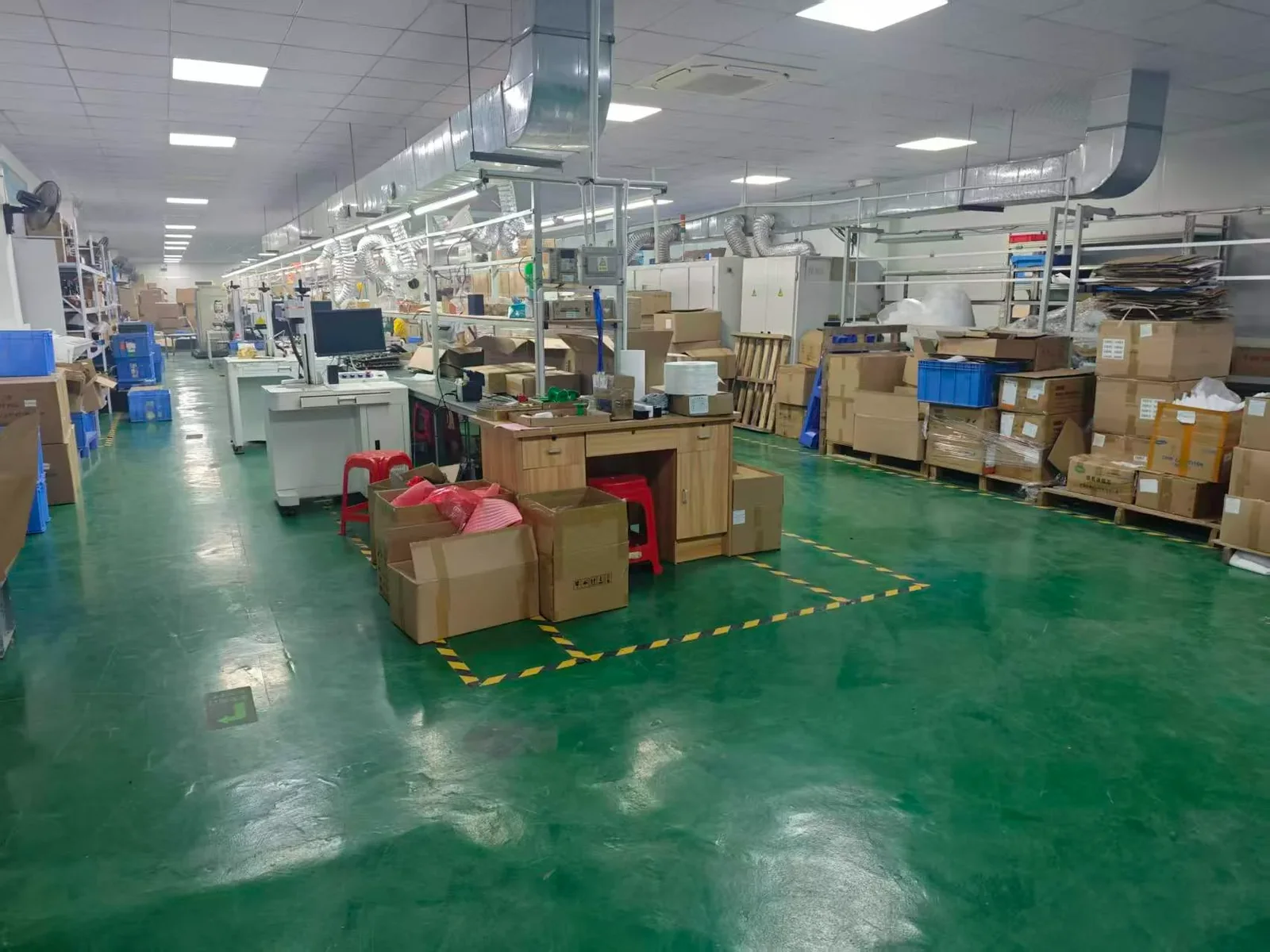
Ask for a live video walkthrough of the assembly floor, not a brochure. A real GaN charger manufacturer OEM shows you hand assembly, ICT/ATE fixtures and a burn-in rack. A trading company shows you a conference room and “our partner factory.” Push for the partner’s name and a direct line. If the supplier won’t name the line that will build your SKU, assume they don’t control it. Confirm business registration, export license and how many years they have shipped chargers — not just power supplies in general.
2. Ask for real certifications, not a logo wall
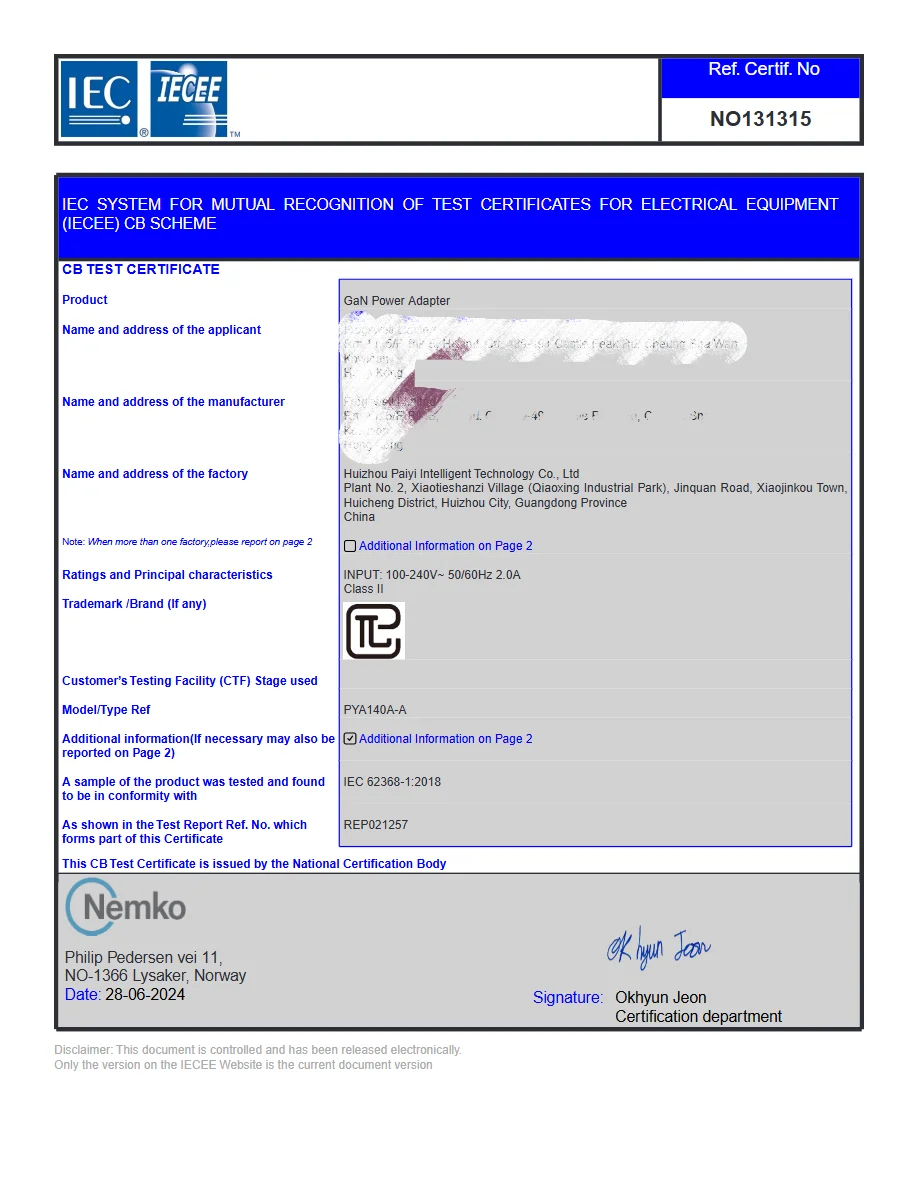
A wall of CE/FCC badges means nothing if the certificate number doesn’t match the exact model and watt class. Request the actual PDFs with the model name, issue date and test lab. For GaN chargers the relevant marks are CE, CB (IECEE), FCC, RoHS and ErP. These are the certificates a competent GaN charger manufacturer OEM holds as standard. Anything missing for your target market is a delay you will own. Verify the cert is current — expired or model-mismatched certs are the most common “silent” gaps.
3. Probe their GaN engineering depth
GaN failures are rarely component failures; they are layout and thermal failures. Ask who designed the transformer and who wrote the firmware. A strong GaN charger manufacturer OEM shows you the schematic review process, the thermal simulation and the EMC pre-scan setup. If the answer is “we buy a turnkey module,” you are buying a box they cannot tune. That is fine for commodity 20W, risky for 100W+ where margin is thin and heat is real. Engineering ownership is the single best predictor of field reliability.
4. Confirm SMT and PCBA capability
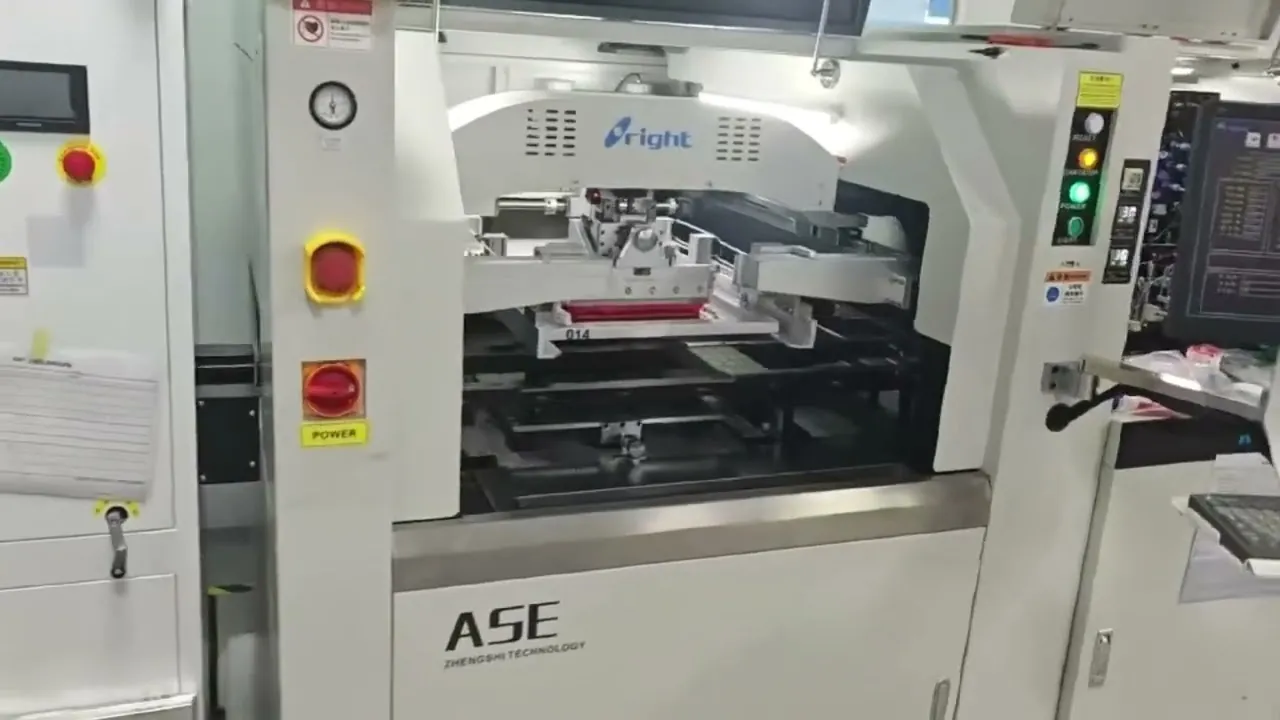
Surface-mount of a dense GaN board needs a precise placement line. Many OEMs outsource SMT and do final assembly in-house — that is normal and acceptable if the hand-off is controlled. The key is incoming inspection of the PCBA, not blind trust. At Paiyi Power the SMT runs at the Tier-1 factory we hold a stake in (Fuji NXT / M3S lines); the board then returns to Huizhou for incoming inspection, assembly, ATE and burn-in. Ask exactly where each step happens and who owns the quality at the boundary.
5. Check production scale and lead-time honesty
Capacity that sounds too good is usually a copy-paste claim. A credible mid-size GaN charger manufacturer OEM states monthly output in concrete units — for example up to 150,000 chargers across four lines — and quotes a realistic 5–6 week lead time after sample approval. Beware any factory promising two weeks for a custom 140W tool. Honest lead times protect your launch; fantasy lead times cause the stockouts that kill a product line. Tie the number to your own forecast and ask what happens at 2× volume.
6. Inspect the test and QC process
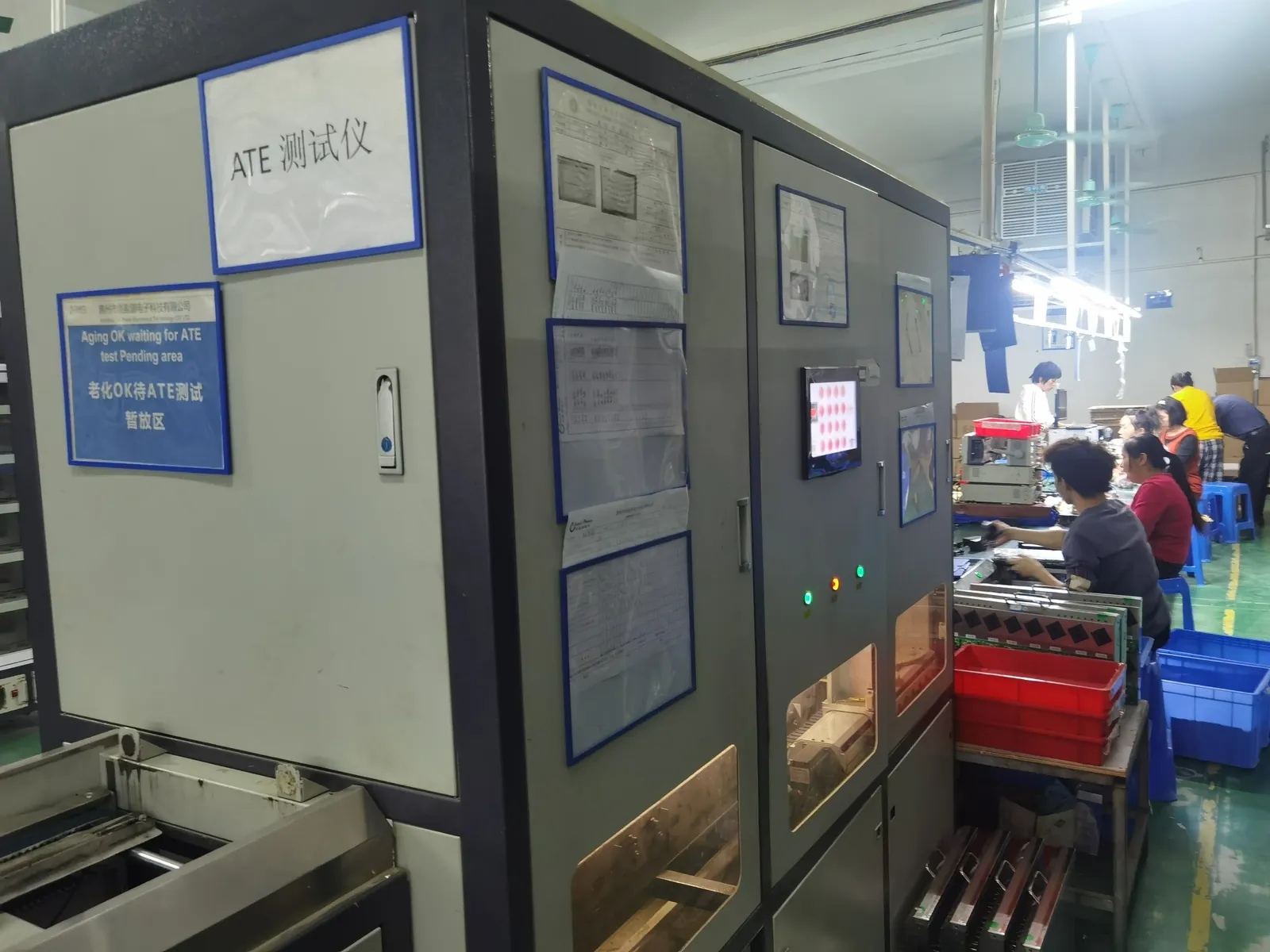
Sampling QC hides batch defects; 100% inspection catches them. Confirm the factory runs ATE (automated electrical test) on every unit plus a burn-in or high-temperature soak, then a final full-function check. A serious GaN charger manufacturer OEM documents the test yield and shares it. Ask to see a recent test report with serial-range coverage, not a single golden sample. If they only “spot check,” quantify the AQL and ask what happens to the rejected lot — that answer reveals how seriously they treat your brand.
7. Evaluate thermal and safety design
Get the thermal margin in writing: case temperature under sustained max load, and the derating behaviour when one port is loaded. A quality GaN charger manufacturer OEM designs the high-voltage rail with a secondary-side supervisor and proper creepage/clearance, not just the minimum to pass. Request the IEC 62368-1 compliance approach and the over-temperature protection behaviour. These are the details that decide whether your charger quietly degrades or safely shuts down in a customer’s home.
8. Review MOQ, tooling and NRE terms
Low MOQ is a feature, not a gimmick, for a startup testing the market. A flexible GaN charger manufacturer OEM offers MOQ around 200 pcs per model for modified-standard builds, with tooling and NRE (non-recurring engineering) scoped per project. Read the NRE clause: is it a one-time fee you own, or a per-order surcharge disguised as tooling? Clarify who keeps the tooling and whether revisions are free within the first year. Unclear NRE terms are where small projects quietly get expensive.
9. Clarify who carries certification cost
The factory’s standard CE/CB/FCC/RoHS/ErP are included; market-specific marks like UL, ETL, UKCA or KC are usually the buyer’s project to fund because they are regional and model-specific. A transparent GaN charger manufacturer OEM states this up front instead of burying it. Ask for a written split: “held by factory” vs “buyer-funded, factory-supported.” Surprises here are the most common cause of a certified product slipping its launch date by a quarter.
10. Assess communication and decision speed
You are not buying a product; you are entering a relationship that will hit at least one crisis. Measure how fast an engineer — not a sales rep — replies to a technical question. A responsive GaN charger manufacturer OEM gives you a named contact who can authorise a design change within days. If every tweak needs a week of “let me check,” your time-to-market will suffer long after the contract is signed. Language matters less than accountability and speed.
11. Request references and verifiable customers
Ask for two references you can actually contact, or case studies with enough detail to verify. A confident GaN charger manufacturer OEM names brands (with permission) or shows shipment records and photos of delivered SKUs. Be wary of “NDA prevents me naming anyone” with zero evidence — some confidentiality is normal, but a total blackout often means no track record. Public, verifiable customers are the strongest signal that the factory ships what it claims.
12. Run a pilot before the full PO
Never jump from sample to full production. Order a pilot of 300–500 pcs, then measure yield, thermal performance and packaging integrity on the actual lot — not the hand-picked sample. A disciplined GaN charger manufacturer OEM treats the pilot as the real qualification. Inspect the pilot with the same checklist above; if the pilot lot diverges from the sample, you have found the truth about their process control before committing a container.
Certification reality check: what “certified” should mean
“Certified” is the most abused word in charger sourcing. A factory can be CE-certified for a 30W model and silently uncertified for the 140W variant you ordered. Always tie the certificate to the exact model and watt class. Also separate “designed to spec” from “certified to spec”: a charger designed to USB PD 3.2 (with SPR AVS) is not the same as a USB-IF-certified charger with a TID number. A honest GaN charger manufacturer OEM says “designed to PD 3.2” when that is the case, and reserves “certified” for marks it actually holds. Read every claim against the certificate PDF, not the sales slide.
GaN vs silicon: the engineering questions to ask
When comparing a GaN charger manufacturer OEM to a silicon-only shop, ask where the difficulty lives. Silicon bricks fail predictably; GaN fails at the edges — EMC, light-load efficiency and thermal runaway under sustained high draw. Probe their EMC pre-compliance data, their light-load efficiency curve and their approach to the 140W 28V rail. A supplier who lights up at these questions is an engineer; one who redirects to price is a reseller. The questions, not the quote, reveal competence.

MOQ, tooling and lead time benchmarks
Use this table as a sanity check when a supplier quotes you. Numbers outside these bands are worth questioning — lower usually means hidden surcharges, higher means you are overpaying for flexibility you may not need. The benchmarks reflect a mid-size GaN charger manufacturer OEM serving custom and modified-standard programs.
| Parameter | Typical (modified-standard) | Typical (full custom ODM) |
|---|---|---|
| MOQ per model | 200 pcs | 500–1,000 pcs |
| Sampling time | ~7 days | 2–4 weeks |
| Mass production lead | 5–6 weeks | 6–8 weeks |
| Tooling / NRE | Often waived | Quoted per project |
| Monthly capacity | Up to 150,000 pcs | Shared with other lines |
Red flags: 7 pitfalls buyers miss
These are the quiet warning signs that surface after you are committed. Catch them in the audit, not in the returns queue.
| Red flag | What it usually means |
|---|---|
| Won’t name the build factory | Trading desk, no process control |
| Cert PDF doesn’t match model | Expired or borrowed compliance |
| “We buy a turnkey module” | No GaN engineering ownership |
| Promises 2-week custom lead | Unrealistic; will slip or cut corners |
| Only spot-checks QC | Batch defects reach your customers |
| Cert cost “included” vaguely | Surprise bill at certification stage |
| No engineer reachable | Slow crisis response, hidden NRE |
A ready-to-send RFQ template
Copy this into your first email to a GaN charger manufacturer OEM. It forces the answers the checklist needs and filters weak suppliers automatically.
- Factory: own line or trading desk? Live video tour available?
- Certs: CE/CB/FCC/RoHS/ErP PDFs for this exact watt class?
- GaN engineering: in-house schematic, thermal and firmware?
- SMT & PCBA: where does it run, and is there incoming inspection?
- Capacity & lead time: at our forecast volume?
- QC: ATE + 100% inspection + burn-in? Show a recent report.
- MOQ, tooling, NRE: itemised, not bundled?
- Cert cost: who funds UL/ETL/UKCA for our market?
- References: two contacts or verifiable case studies?
- Pilot run: 300–500 pcs before the full PO — yes or no?
Pilot run: what to measure before the full order
The pilot is where claims meet reality. On the pilot lot, measure: electrical output at each port combination, efficiency at 25%/50%/100% load, case temperature under sustained max draw, EMC pre-scan, and drop/packaging integrity. Compare against the sample you approved. A trustworthy GaN charger manufacturer OEM expects this and provides the test data themselves. If the pilot lot is materially worse than the sample, stop — you have just saved a container of returns. Document the pilot result as the acceptance baseline for mass production.
How Paiyi Power runs the 12 checks
For transparency, here is how we score on the checklist above. Paiyi Power is a Huizhou-based GaN charger manufacturer OEM (founded Shenzhen 2015, Huizhou plant 2019, ~50 people) with four lines and monthly capacity up to 150,000 units. We hold CE, CB, FCC, RoHS, ErP and ISO 9001, run 100% ATE with full inspection and burn-in, and quote 5–6 week lead times. SMT runs at the Tier-1 factory we hold a stake in (Fuji NXT / M3S); the board then returns to Huizhou for incoming inspection and assembly. UL/ETL/UKCA are buyer-funded and factory-supported, MOQ starts at 200 pcs per model, and we treat the pilot run as the real qualification — the same standard we ask you to apply to us.
Frequently asked questions
What does a GaN charger manufacturer OEM actually do?
A GaN charger manufacturer OEM designs and builds gallium-nitride chargers to a brand’s specification. The scope can be pure manufacturing (OEM, your design) or design-plus-build (ODM, their design). Core work includes PCB layout, GaN device selection, transformer winding, enclosure tooling, firmware for USB Power Delivery, safety certification support and final assembly with electrical test and burn-in.
How is a GaN charger OEM different from a trading company?
A genuine factory owns the assembly line, QC and (ideally) the engineering; a trading company brokers between you and an unnamed line. The practical test is a live floor tour and a named build location. If the supplier cannot show you the line that will build your SKU, you are not dealing with a GaN charger manufacturer OEM — you are dealing with a reseller.
What certifications should a GaN charger OEM hold?
For general markets the baseline is CE, CB (IECEE), FCC, RoHS and ErP, all current for your exact model and watt class. These are the marks a competent GaN charger manufacturer OEM holds as standard. Regional marks such as UL, ETL, UKCA or KC are usually buyer-funded because they are market-specific; the factory should support the filing rather than hold the certificate.
Do I need the factory to be USB-IF certified for PD 3.1/3.2?
Not necessarily. Most chargers are “designed to USB PD 3.2 specification (with SPR AVS)” rather than holding a USB-IF TID. Ask the GaN charger manufacturer OEM which PD revision their firmware targets and whether the high-voltage rail is supervised. Reserve “USB-IF certified” only for suppliers who can show a valid TID number — and know that many excellent factories ship without one.
What is a realistic MOQ and lead time for GaN chargers?
For modified-standard builds, MOQ around 200 pcs per model is realistic; full custom ODM often starts at 500–1,000 pcs. Sampling is about a week for modified-standard and 2–4 weeks for custom; mass production typically runs 5–6 weeks after sample approval. Any quote far outside these bands deserves a second look.
Should SMT be in-house or outsourced?
Outsourced SMT is normal and not a red flag, provided the hand-off is controlled. What matters is incoming inspection of the PCBA and clear ownership of quality at the boundary. A transparent GaN charger manufacturer OEM tells you exactly where SMT happens and how the returned board is verified before final assembly.
How do I verify a factory’s real production capacity?
Ask for monthly output in concrete units, the number of active lines, and how they handle a 2× surge. Then verify with a video tour and a reference who received volume. Capacity claims are easy to inflate; a credible GaN charger manufacturer OEM states numbers you can reconcile against their floor and their references.
Who pays for safety certification — buyer or factory?
The factory’s standard marks (CE, CB, FCC, RoHS, ErP) are included. Market-specific marks (UL, ETL, UKCA and similar) are typically the buyer’s project to fund because they are regional and model-specific, with the factory supporting the submission. A transparent GaN charger manufacturer OEM states this split in writing before you sign.
What should a pilot run check before the full order?
Order 300–500 pcs and measure output at each port combination, efficiency at 25/50/100% load, sustained case temperature, EMC pre-scan and packaging integrity — then compare against the approved sample. A disciplined GaN charger manufacturer OEM provides this data themselves; if the pilot diverges from the sample, fix the process before committing volume.
Sources
- USB Implementers Forum — USB Power Delivery specification
- IEC — IEC 62368-1 (audio/video/ICT equipment safety)
- Energy Star — External Power Supplies program
- Wikipedia — Gallium nitride (GaN) basics
- U.S. DOE — efficiency regulations for external power supplies
Related reading
- High-power charging: premium ODM for 100W–140W GaN
- Inside Paiyi Power: R&D to 100% inspection
- Certifications we hold (CE/CB/FCC/RoHS/ErP, ISO 9001)
- CPAP power supply OEM: the healthcare-standard angle
- Water-purifier power supply OEM: a vertical deep-dive
- Linear-actuator power supply OEM: another vertical