
140W GaN Charger Supplier Guide: Single-Port vs Multi-Port Power Allocation
Published: September 2026
Reading time: 14 min
Audience: Procurement leads and brand owners deciding between single-port and multi-port 140W chargers, who need the power-allocation and thermal questions answered before they send an RFQ.
By Han — Paiyi Power, a Huizhou-based power supply OEM/ODM and working 140W GaN charger supplier (custom units 5W–240W, designed to USB PD 3.2 with SPR AVS) that holds CE/CB/FCC/RoHS/ErP and ISO 9001, at MOQ 200 pcs per model.
Last updated: 29 September 2026.
Contents
Direct answer: how to brief a 140W GaN charger supplier
Brief a 140W GaN charger supplier with five inputs and two dates. The inputs: port layout (1C, 2C or 2C1A), the power-allocation table for every device combination, EPR support at 28V/5A so one port really delivers 140W, the certification list per destination market, and the mechanical envelope including plug style and cable. A “140W total” claim means nothing until it is written per port, per combination. The dates: sampling and mass production. A modified-standard 140W build samples in about 7 days; a full custom ODM development takes 2–4 weeks; mass production runs 5–6 weeks after sample approval. A serious 140W GaN charger supplier answers both dates in the first call, with the allocation matrix attached.
Then pin the commercial floor in writing: MOQ 200 pcs per model for a modified-standard unit, 500–1,000 pcs for a full custom ODM build, and 100% final inspection — ATE functional test plus burn-in — before anything ships. Ask the 140W GaN charger supplier to state, inside the RFQ response, which combinations hold full wattage and which share it. Everything else in this guide is the detail behind those two paragraphs.
Why 140W became the laptop-charger standard
140W is where the USB market converged because of one number: 28 volts. Extended Power Range (EPR), introduced with USB PD 3.1 and carried into PD 3.2, added fixed voltages up to 28V at 5A — and 28V × 5A is exactly 140W. That is the ceiling the major laptop vendors standardized on for 16-inch productivity and creator machines, so a 140W GaN charger replaces the proprietary brick in the box. When buyers ask how PD 3.1 differs from PD 3.2, the practical answer is maturity: PD 3.2 keeps EPR and refines SPR AVS. We cover the full ladder in our PD 3.1 vs PD 3.2 comparison.
For a brand, 140W is also a margin story. The charger that ships with a premium laptop is the accessory owners replace first when it is lost, and they pay for the wattage they recognize on the box. A single 140W SKU covers every USB-C device below it, which simplifies both the catalog and the spare-parts bin.
Single-port 140W: maximum power, minimum logic
A single-port 140W charger is the simplest defensible product in the category. One USB-C connector receives the full 140W through the EPR 28V contract; there is no arbitration firmware to trust, no allocation matrix to audit, and no renegotiation behavior to test. The thermal budget belongs to one path, so case temperature at full load is predictable, and the BOM is shorter — fewer port controllers, fewer protection circuits, fewer things to fail in the field.
Choose single-port when the positioning is premium and single-device: the laptop owner who wants one fast brick and nothing else. The trade-off is shelf appeal in a multi-device world, where a 2C1A SKU wins the “one charger for everything” argument. Also note that an SPR-only competitor tops out at 100W, whatever the box implies — insist on EPR in the datasheet, and model the cable loss with a voltage-drop calculator before you freeze the cable spec.
Multi-port 2C1A: the power-allocation problem
A 2C1A 140W charger is an allocation machine with a shell around it. The moment a second device plugs in, the firmware must decide what to give up: drop the laptop port from 140W to 100W, split 65/45 between the two USB-C ports, keep 20W on the USB-A puck for the watch or earbuds. Every brand has read a review that says “it slowed down when I plugged in my phone” — that is allocation behavior, badly specified, showing up in public.
Demand three things from the datasheet. First, the written allocation matrix per combination — the same table shown in the next section. Second, the renegotiation rule: when the third device hot-plugs, the laptop port should re-contract without collapsing to zero, because a device that reboots mid-charge is a return. Third, the legacy rule for USB-A, which has no PD contract and simply takes what the policy engine leaves. And because EPR at 28V only works on 5A-rated cables, tie the cable requirement into the RFQ — our 240W USB-C cable guide covers the rating marks to check.
How a 140W GaN charger supplier allocates power across ports
The allocation matrix is the single most important page in a 140W multi-port datasheet, and a serious 140W GaN charger supplier publishes it before you ask. The table below is the matrix we hand buyers for a 140W 2C1A reference build: each row is a device combination, each column the negotiated power on that port, and every row sums to the shell’s real thermal envelope — never to a marketing total.
| Connected devices | USB-C1 | USB-C2 | USB-A | Total draw |
|---|---|---|---|---|
| Laptop only (EPR 28V) | 140W | — | — | 140W |
| Laptop + phone | 100W | — | 20W | 120W |
| Laptop + tablet | 100W | 30W | — | 130W |
| Laptop + tablet + phone | 100W | 25W | 15W | 140W |
| Laptop + two phones | 65W | 45W | 20W | 130W |
| Tablet + two phones (no laptop) | 45W | 45W | 20W | 110W |

Allocation is implemented twice: once in hardware headroom and once in firmware policy. The power stage is sized so the worst simultaneous draw stays inside the thermal envelope, and the PD policy engine in the controller enforces the matrix port by port, renegotiating on every hot-plug event. Ask the 140W GaN charger supplier whether the matrix is static (fixed caps per port) or dynamic (load-aware re-split); both are legitimate, but they behave differently when a laptop sags its draw mid-session, and your users will notice the difference before your returns dashboard does.
Then test the matrix, not the datasheet. In the pilot run, plug in every combination in the table and log what each port actually negotiates — a 140W GaN charger supplier whose real behavior drifts from the published matrix by more than a few watts has a firmware or thermal problem that volume will amplify. Our 100W+ GaN charger OEM guide shows how the same matrix discipline scales to 140W and above.
Where SPR AVS fits in the 140W power ladder
USB PD 3.2 divides the world into two ranges. The Standard Power Range (SPR) covers contracts up to 100W at fixed voltages of 5V, 9V, 15V and 20V, plus Adjustable Voltage Supply (AVS), which lets the charger fine-tune the voltage in small steps between 15V and 20V. The Extended Power Range (EPR) adds 28V, 36V and 48V — and 140W only exists at the EPR 28V/5A contract. So a 140W charger is an EPR device that still spends most of its working day inside SPR.
Why the buyer should care: AVS is where GaN efficiency gains become visible, because the converter can sit at the voltage that minimizes switching loss instead of a legacy fixed rail. When you brief the 140W GaN charger supplier, ask for AVS on the SPR ports and EPR on the primary port, and ask how the firmware chooses between them per device. Certification paperwork follows the same ladder — our USB PD 3.2 certification overview lists what test houses expect from EPR builds.
Thermal design: why 140W is a thermal problem first
At 140W, the design problem is heat before it is electronics. Roughly 8–12% of delivered power becomes waste heat in a well-built GaN stage — 11 to 17 watts in a shell that fits a palm — and that heat has one exit: the case. GaN devices cut switching loss enough to make the form factor possible at all, but they do not delete the thermal path; they shrink it. Everything else in the build — potting compound, thermal pads, the shell acting as the radiator — exists to move those watts out.
This is where a 140W GaN charger supplier earns the name. Ask for the derating curve (output versus ambient temperature), the case temperature at full load in a 25 °C room, and where the hottest spot sits — near the plug, the transformer, or the port barrel. Typical well-built units hold the external case at or below about 65 °C at full load, but the number that matters is the curve, not the claim. Losses in the cable and connector draw from the same budget, so model them before freezing the shell size.
One practical gate belongs in your acceptance criteria: no user-visible throttling at rated load in a 25 °C room for 30 minutes. A charger that silently derates after ten minutes at its headline wattage has a thermal design your box copy will contradict, and reviewers will find it first.
GaN devices and topology choices at 140W
Two topology families dominate 140W builds. Active-clamp flyback is the workhorse: one main switch, an auxiliary clamp that recovers leakage energy, cheap to drive, comfortable at higher switching frequencies with GaN FETs. LLC half-bridge appears in premium SKUs where efficiency at 25–50% load matters more than BOM cost, because it switches with zero-voltage transitions across the load range. GaN transistors — versus legacy silicon MOSFETs — switch faster with less energy stored, so the magnetics shrink and the transformer fits a pocketable shell.
Ask the 140W GaN charger supplier which topology each SKU uses and why, and ask where the power stage is actually assembled. Paiyi Power’s power stages are placed at the Tier-1 SMT factory Paiyi Power holds a stake in, which runs Fuji NXT / M3S lines; the boards return to Huizhou for incoming inspection, manual assembly of the safety-critical wiring, 100% ATE and burn-in. A supplier that cannot name its SMT line, its reflow ownership, and its incoming gate is reselling, not manufacturing.
Firmware and protocol questions to put to your 140W GaN charger supplier
Firmware decides how the charger behaves on the bad days: the hot-plug at 140W, the phone that renegotiates mid-session, the laptop that sags its draw. These are the questions that separate an engineered policy engine from a chip vendor’s default, so put them in writing with the RFQ. The table below pairs each question with the answer a competent supplier gives and the red flag that should stop the call.
| Question | Good answer | Red flag |
|---|---|---|
| Which PD specification does the build follow? | Designed to USB PD 3.2 specification (with SPR AVS) and EPR 28V | Vague “latest PD” with no revision named |
| Can you show the port-allocation matrix? | Published matrix per combination, tested in pilot | “It balances automatically” with no table |
| What happens when a third device hot-plugs? | Soft renegotiation; the laptop holds its contract | Devices reboot or the output collapses |
| How is firmware versioned and locked? | Checksummed builds, frozen version per production lot | “Firmware comes in the chip” |
| Which protections run on 100% of units? | OVP/OCP/OTP/SCP limits written per port, logged at ATE | “All standard protections” with no limits shown |
Keep the answers in the same folder as the frozen BOM, because firmware and hardware drift together: a new PD controller stepping onto the BOM silently rewrites the allocation matrix you approved. Change control — the 140W GaN charger supplier proposes, you approve, the build is re-qualified — is what keeps the 50,000th unit identical to the sample you signed.
The spec sheet a 140W GaN charger supplier should hand you
A complete 140W spec sheet has six pages, and every one of them is a question you no longer have to ask. Page one: the electrical table per port — voltage and current steps, EPR and SPR AVS support, PPS range if offered. Page two: the allocation matrix from the section above. Page three: the derating curve and case-temperature data. Page four: the frozen BOM with the power stage called out. Page five: the production test limits the ATE actually enforces. Page six: the model-specific certificate PDFs — CB, CE, FCC, RoHS, ErP — with the model number matching your build, not a family cert covering a different watt class.
The refusal test is simple: ask for pages two and five before the first call ends. A real 140W GaN charger supplier sends them the same day, because both already exist for every shipping SKU. A trader sends a marketing PDF with a lightning bolt on the cover and asks for your target price instead — which answers a different question entirely.
Certification path for a 140W SKU
A 140W SKU carries more certification weight than a 65W one because EPR raises the stakes: 28 volts at 5 amps pushes creepage, isolation and single-fault requirements harder under IEC 62368-1, the governing safety standard for audio/video and ICT equipment. The practical path runs through the IECEE CB Scheme — one national-lab report recognized across member countries — which then converts into the CE declaration for Europe and supports FCC Part 15 Subpart B for conducted and radiated emissions in the US. RoHS and ErP round out the EU paperwork.
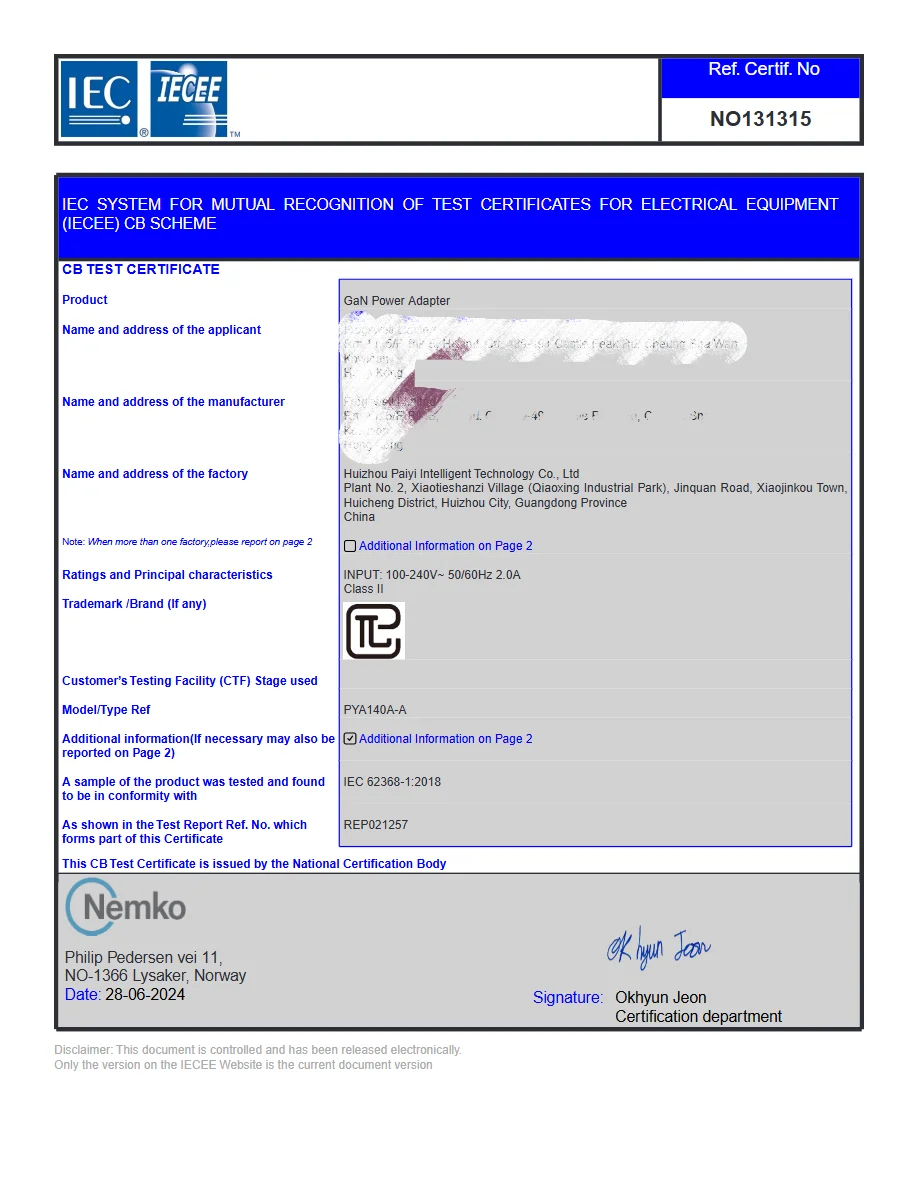
Hold the line on what “certified” means. CE, CB (IECEE), FCC, RoHS and ErP, plus ISO 9001 for the quality system, are the marks a working factory holds as standard; UL, ETL and UKCA are buyer-funded, project-by-project, and a competent supplier supports the testing without claiming marks it does not hold. And no USB-C charger should carry a USB-IF certification claim unless the 140W GaN charger supplier can produce the TID — which is why we describe our builds as designed to USB PD 3.2 with SPR AVS, a testable claim, rather than waving a membership badge.
Pilot run: what to measure before mass production
The pilot run converts the datasheet into evidence, so define the measurements — and the pass bands — before the first unit is built. The table below is the pilot scorecard we run with buyers on 140W programs; the bands are typical industry values for a mature GaN design, to be frozen with your own limits at the pilot review.
| Measurement | Method | Pass band |
|---|---|---|
| Per-port voltage accuracy | ATE sweep at 25/50/100% load on each port | Within ±5% of negotiated voltage (typical) |
| Ripple and noise | Oscilloscope at 20 MHz bandwidth, full load | Below ~100 mV peak-to-peak (typical band) |
| Full-load case temperature | Thermocouple at rated 140W, 25 °C ambient | ≤ ~65 °C on the external shell (typical target) |
| Efficiency at 25/50/100% load | Power analyzer, measured per port | ~88–93% across the three points (typical GaN) |
| Burn-in yield | 100% aging at rated load before packing | ≥ ~99% first-pass on a mature build (typical) |
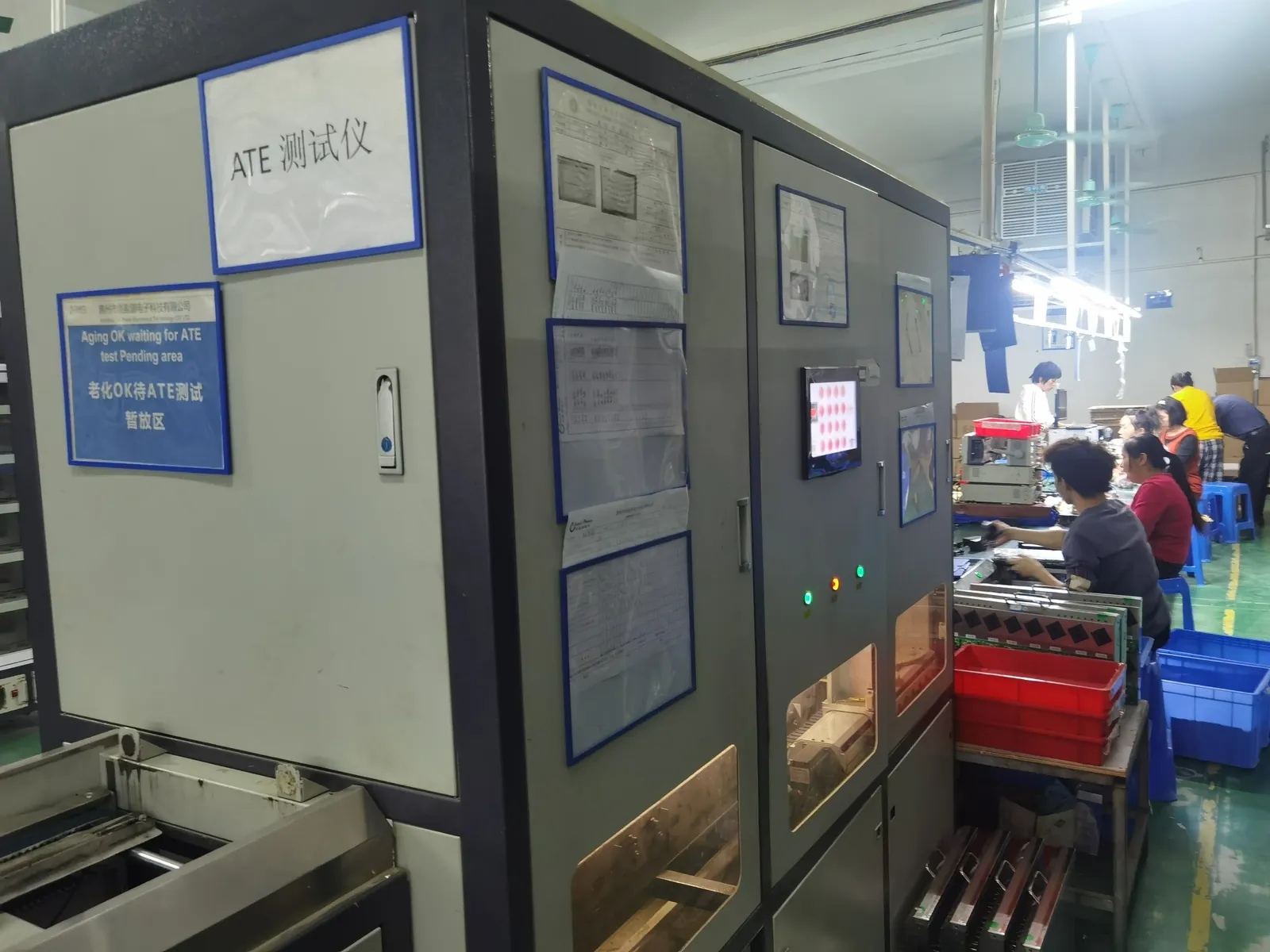
Two timeline facts belong next to the scorecard. A modified-standard 140W build samples in about 7 days, because the platform exists and the changes are electrical or cosmetic; a full custom ODM program takes 2–4 weeks to first samples, because the power stage, allocation firmware and shell are designed together. Mass production then runs 5–6 weeks after sample approval. Anything quoted faster than that for a custom 140W build is borrowing time from testing you will pay for in the field.
On the line itself, insist on 100% final inspection: ATE functional test on every unit plus burn-in on every unit, with the reject log available per lot. A supplier that samples either check is shipping you the tail of the distribution and calling it a yield.
Vetting the 140W GaN charger supplier behind the datasheet
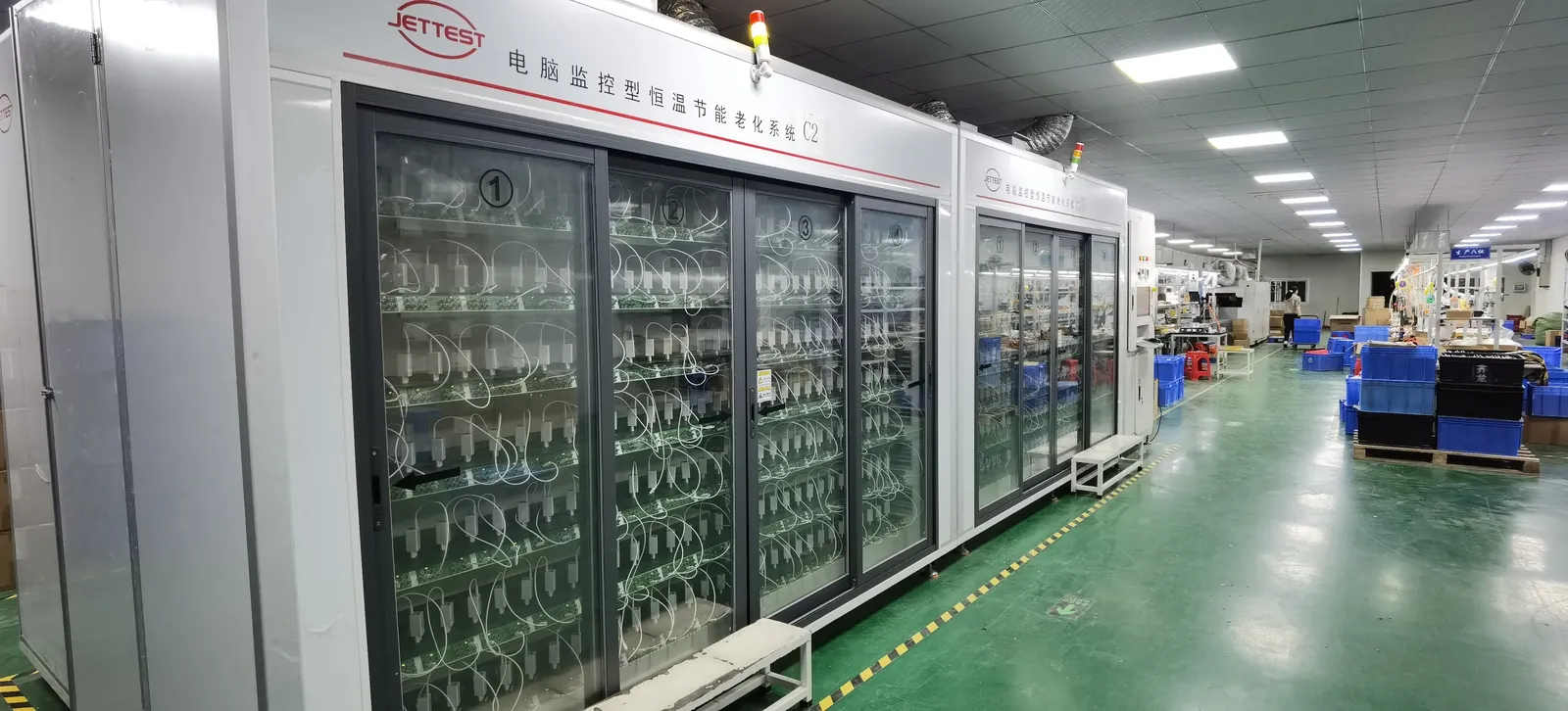
The datasheet tells you what the 140W GaN charger supplier designs; the floor tells you what it builds. Vetting a 140W GaN charger supplier comes down to four verifiable facts. Who assembles the boards — a named SMT partner with an incoming-inspection gate, or silence. Who owns final test — 100% ATE plus burn-in with logs, or a claim. What the capacity is — ours is up to 150,000 units a month across four manual assembly and QC lines at the Huizhou plant, with engineering in Shenzhen since 2015 and the plant since 2019, around 50 people. And what the certificates cover — model-specific PDFs, not family certs.
Then price the relationship, not just the unit. MOQ 200 pcs per model on a modified-standard build, 500–1,000 pcs for full custom ODM, sampling in about 7 days or 2–4 weeks, and mass production 5–6 weeks after sample approval — numbers a factory states without flinching. For the deeper questions to ask, our 12-point manufacturer checklist walks the whole vetting visit, and you are welcome to run it on our floor in Huizhou.
Frequently asked questions
The 140W questions buyers ask most, answered straight.
Is 140W real on all ports at the same time?
No, and it should not be. 140W is the shell’s total thermal envelope, reached when a single EPR device takes the full output. On a 2C1A build the firmware distributes it — for example 100W to the laptop, 25W to a tablet and 15W to a phone — and every row of that matrix should sum to 140W or less. Any supplier promising 140W per port on a multi-port shell is quoting a number the power stage cannot deliver.
What is EPR and why does it matter at 140W?
EPR — Extended Power Range — is the part of the USB PD specification that adds fixed voltages above 20V: 28V, 36V and 48V. 140W only exists at the EPR 28V/5A contract; within the Standard Power Range a port tops out at 100W. That is why a genuine 140W charger is an EPR device, why it needs 5A-rated cables, and why the certification report must cover EPR operation under IEC 62368-1 rather than reusing a 65W-era template.
Can one 140W charger replace my laptop and phone chargers?
Yes — that is the point of the category. A 140W 2C1A unit carries a 16-inch laptop at full EPR speed, fast-charges a phone on the second USB-C port, and keeps 20W on USB-A for a watch or earbuds. The one honest caveat is simultaneous use: the total is shared per the allocation matrix, so the laptop and the phone both charge, just not both at their individual maximums at the same moment.
Why does my charger slow down when I plug in three devices?
Because the power-allocation policy is doing its job — or exposing its absence. With three ports drawing, the firmware re-splits the 140W envelope: typically the laptop drops to around 100W or less, the second port takes 20–45W, and legacy USB-A takes what remains. If your charger reboots devices or collapses output during renegotiation, the policy engine is poorly implemented — ask the 140W GaN charger supplier for the written matrix and the hot-plug behavior spec.
What should an RFQ for a 140W charger contain?
Five inputs: port layout, the allocation matrix per device combination, EPR and SPR AVS support, the certification list per destination market, and the mechanical envelope including plug style. Add the commercial frame: target MOQ — 200 pcs per model for modified-standard, 500–1,000 pcs for full custom ODM — plus the sampling timeline and the pilot measurements you will hold the build to. A supplier that returns a complete RFQ response inside a week is a factory; one that returns a price list is not.
Does a 140W charger need different certification than a 65W one?
The framework is the same — IEC 62368-1 safety, FCC emissions, RoHS and ErP — but 140W raises the bar inside it. The EPR 28V/5A contract tightens creepage, isolation and single-fault requirements, so the CB report must cover EPR operation explicitly, and thermal evidence carries more weight. UL, ETL or UKCA marks are buyer-funded additions at either wattage. Ask for the model-specific certificate PDFs and check that the ratings match your build.
What MOQ should I expect for a 140W build?
Expect around 200 pcs per model for a modified-standard build — an existing 140W platform with your shell, plug or branding — and 500–1,000 pcs for a full custom ODM program with a new power stage or allocation firmware. Below that, a 140W GaN charger supplier is either batching you into someone else’s production or planning to resell stock. Pilot quantities ahead of the MOQ are normal on both tracks and worth requesting in the RFQ.
How long does sampling take for a 140W charger?
About 7 days for a modified-standard build, because the platform, firmware and certification base already exist and your changes are electrical or cosmetic. A full custom ODM development takes 2–4 weeks to first samples, since the power stage, allocation firmware and shell are designed together. Mass production then runs 5–6 weeks after sample approval. Ask for both dates in the RFQ response and hold the 140W GaN charger supplier to them in the pilot plan.
How do I verify a 140W GaN charger supplier actually builds 140W units?
Ask for evidence in layers: the model-specific CB/CE certificate PDFs with matching ratings, the allocation matrix and test limits from a shipping SKU, recent ATE lot data, and a live or on-site walk of the assembly, test and burn-in lines. The burn-in racks should be loaded and running. If the SMT step is partnered, the 140W GaN charger supplier should name the partner and its incoming-inspection gate without prompting — precision there is the cheapest honesty test available.
Sources
- USB Implementers Forum — USB Power Delivery specification
- IEC — IEC 62368-1 (audio/video/ICT equipment safety)
- IECEE — CB Scheme (global certification for electrical equipment)
- Energy Star — External Power Supplies program
- Wikipedia — Gallium nitride (GaN, material overview)
Related reading
- 100W+ GaN charger OEM: the complete selection guide
- PD 3.1 vs PD 3.2: what EPR and AVS buyers should choose
- How to vet a GaN charger manufacturer: 12-point checklist
- 240W USB-C cable requirements: EPR cables explained
- USB PD 3.2 certification: timeline and costs
- High-power charging: premium ODM for 100W–140W GaN