
High-Power Charging & Premium ODM
Build the Power Platform for High-Power Charging & Premium ODM
PaiYi supports specification-led, high-power charging and premium power ODM development for brands that need more than a commodity adapter. The electrical targets below remain open until the product category, power profile, target market and operating environment are confirmed.
High-Power Charging Power Supply Design Priorities
The final architecture should be selected from real product requirements rather than a fixed catalogue assumption.
Input and Output Definition
Confirm the input source, normal operating range, transient conditions, required output rails, regulation and sequencing expectations.
Power and Standby Demand
Define continuous and peak loads, fast-charging behavior and sleep, wake-up and standby consumption targets.
Efficiency and Thermal Design
High efficiency (≥94%) reduces heat and enables compact, high power-density designs that lower system cost.
Protection and Safety Certification
Specify input, output and thermal protection behavior, fault reporting and the required safety certification path (UL / CE / CCC).
Mechanical and Integration
Review enclosure, PCB or module format, dimensions, mounting, connectors and coexistence with wireless or connectivity modules.
EMC and Market Compliance
Evaluate emissions, immunity, surge and transient requirements for the target retail market and use environment.
Featured Application
High-Power Applications We Engineer For
High-power charging is not one product category. AI PCs pair an NPU with discrete graphics and push adapter demand to 140W–330W; the same platform work carries into multi-port docks, portable power stations, mini PCs and open-frame industrial modules. PaiYi develops high-density GaN adapters and USB-C PD 3.1 EPR supplies across that range, with PD 3.2 SPR AVS designed in.
AI PC & Creator Workstations
GaN adapters from 140W to 330W for Intel® Core™ Ultra, AMD Ryzen™ AI and Copilot+ PC laptops, holding voltage steady through NPU plus dGPU transient load steps.
Multi-Port Desktop & Docking
Shared-budget power management across four to six ports: up to 240W (28V/5A) on the primary port, with the remainder distributed by firmware policy.
Portable Power Stations
High-power USB-C PD input stages and external adapters for portable power stations, covering pass-through charging and the solar input boundary.
Mini PC, Edge & Industrial
Sustained 19V/20V rails and 240W to 330W open-frame modules for fanless mini PCs, edge-compute boxes and industrial equipment.
Application notes on this blog: portable power station chargers, mini PC power adapters, drone battery chargers, LEV chargers and AGV charging stations.
Preliminary Specification Worksheet
Values are intentionally left open for engineering review. They will be completed only after the project requirements are supplied.
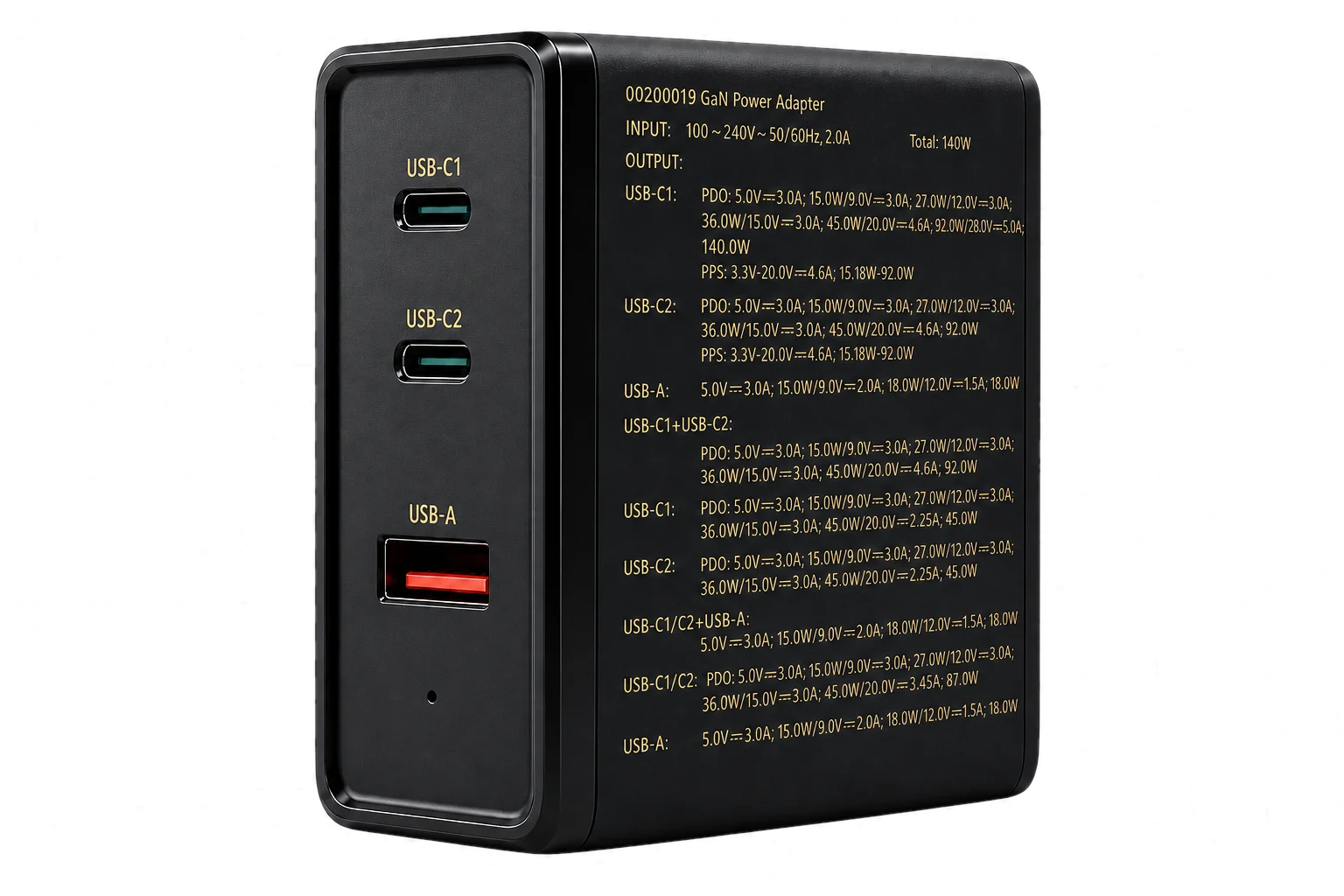
PY-DC-GaN-140W — 140W GaN Charger (2C1A)
A shipped, certified example of our high-power GaN ODM platform: full-speed PD 3.1 EPR on a single port plus two extra devices, in a compact 2C1A body.
Why it stands out
- Full-speed laptop + 2 more devices. USB-C1 delivers the complete 140W (28V/5A) to a 16″ laptop, while USB-C2 and USB-A keep a phone and earbuds charging at the same time — something a single-port 140W brick cannot do.
- Compact for a true 2C1A 140W unit. 78×77×30 mm / 0.35 kg (~180 cm³), smaller than comparable 2C1A 140W chargers.
- Up to 93.25% efficiency at 28V/5A (single-port, 100% load); EU ErP (Reg. 2019/1782) compliant.
- Universal protocols: USB PD 3.1 / PD 3.0 / PPS / QC — MacBook, iPad, iPhone, Galaxy, Steam Deck.
- Certified safe: IEC 62368-1 (CB Scheme) + CE + RoHS + ErP, with OVP / OCP / OTP / SCP and CB-tested fault auto-shutdown.
This is one shipped reference configuration. The Preliminary Specification Worksheet above remains open for custom project requirements (power profile, target market, operating environment).
Integration with the Product System
A consumer electronics supply operates inside a wider product. Review of the surrounding system helps prevent late changes during validation.
System Context to Confirm
Product enclosure and airflow, AC/DC or DC/DC topology, fast-charging protocol (USB PD / proprietary), safety certification target, wireless and connectivity co-existence, thermal environment, target retail market and regulatory region.
OEM / ODM Development Scope
The project scope is defined jointly and documented before sampling.
Electrical and Mechanical Options
- Input and output configuration
- Power, efficiency and standby targets
- Protection and thermal design scope
- Charging protocol and connector definition
- Housing, dimensions, mounting and labeling
Information Needed for Evaluation
- Product category and target use case
- Power profile and required output rails
- Target market and compliance requirements
- Operating environment and service-life expectation
- Mechanical drawing, connector definition and order forecast
From Requirement Review to Production
Requirement Review
Confirm the electrical, mechanical, environmental and compliance inputs.
Architecture Proposal
Define the power platform, open items, validation scope and development path.
Sample Validation
Evaluate samples against agreed operating modes, faults and system conditions.
Production Readiness
Finalize approved specifications, documentation and manufacturing requirements.
Frequently Asked Questions
Who designs the GaN charger: power architecture, PCB, transformer, firmware/protocol and EMC?
What high-power applications do you build for?
Can you build a charger above 240W?
What does PaiYi offer for high-power charging?
Can you do premium ODM for charging brands?
What certifications are needed for chargers?
Do you support both AC and DC charging power?
What wattage power adapter do AI PCs need?
Do you build GaN chargers for AI laptops?
Can you support AI workstation power up to 330W?
Discuss Your High-Power Charging Requirements
Share your target application, available specification, block diagram or operating conditions for an initial engineering review.