

USB PD 3.2: O Que Muda para Fabricantes e Compradores B2B
Publicado: Setembro de 2026
Tempo de leitura: 5 min
Público: OEM manufacturers, buyers, importers and brands sourcing power supplies and chargers
Por Han - Paiyi Power, fabricante OEM/ODM de carregadores GaN e fontes de alimentação externas, trabalhando com clientes B2B internacionais na certificação USB-IF.
Última atualização: 6 de setembro de 2026.
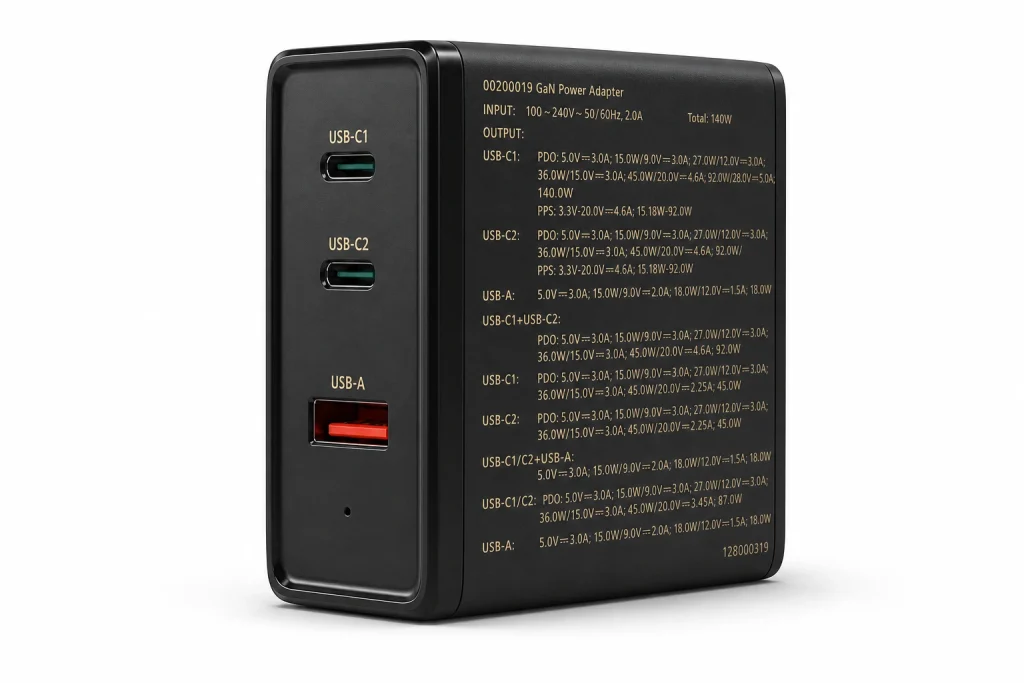
Paiyi Power 140W USB PD 3.2 SPR AVS GaN charger, designed for OEM/ODM buyers sourcing USB Power Delivery 3.2 products.
Conteúdo
Direct answer: what changes in USB PD 3.2?
USB PD 3.2 makes AVS (Adjustable Voltage Supply) mandatory for any power source above 27W. Instead of being locked to the fixed 5V / 9V / 15V / 20V steps, the charger adjusts its output voltage in 100mV increments: 9V to 15V on sources up to 45W, and 9V to 20V on sources above 45W. Maximum power does not change — it stays at 240W in EPR. What changes is efficiency and heat, precisely in the 27W–100W band that accounts for most of the charger market.
What is USB PD 3.2?
USB Power Delivery 3.2 (PD 3.2) is the revision of the USB-IF fast-charging standard released in October 2023; the current release is USB PD R3.2 V1.2, published 20 May 2026. Its purpose is to bring to the mid-power band (27W–100W) the same efficiency benefits that previously existed only in high-power chargers above 140W.
In practice, PD 3.2 means chargers that run cooler, waste less energy and put less thermal stress on batteries — while staying compatible with older chargers and devices.
The specification is also published as an IEC standard: IEC 62680-1-2:2024 is the IEC edition of USB Power Delivery Specification Revision 3.2, Version 1.0.
USB PD 3.2 vs PD 3.1: what is the difference?
| Feature | USB PD 3.1 | USB PD 3.2 |
|---|---|---|
| Potência máxima | 240W (48V / 5A) | 240W (48V / 5A) — unchanged |
| AVS available | EPR only (above 100W, 15V–48V) | Also in SPR (27W–100W) |
| SPR AVS window | Not applicable | 9V–15V up to 45W; 9V–20V above 45W |
| Adjustment step | 100mV (EPR) | 100mV (SPR and EPR) |
| Target devices | High-performance notebooks and workstations | Notebooks, tablets, smartphones and mid-power devices |
Where AVS applies in each mode (reference table)
| Modal | Introduced in | Voltage range | Etapa | Faixa de potência |
|---|---|---|---|---|
| Fixed PDO (SPR) | PD 1.0–3.0 | 5V / 9V / 15V / 20V | - | up to 100W |
| SPR AVS (sources up to 45W) | PD 3.2 | 9V – 15V | 100mV | 27W – 45W |
| SPR AVS (sources above 45W) | PD 3.2 | 9V – 20V | 100mV | 45W – 100W |
| EPR AVS | PD 3.1 | 15V – 48V | 100mV | above 100W, up to 240W |
| Fixed PDO (EPR) | PD 3.1 | 28V / 36V / 48V | - | up to 240W (48V / 5A) |
| PPS (SPR APDO) | PD 3.0 | from 5V | 20mV | up to 100W |
Two details that are often misread: AVS does not replace PPS (a charger may advertise both), and EPR AVS still exists in PD 3.2 — what is new is that AVS is now also required in the SPR band, below 100W.
The main difference is that PD 3.2 extends AVS to the power band that serves most of the market.
SPR AVS: the change that matters
SPR AVS (Standard Power Range Adjustable Voltage Supply) is the heart of PD 3.2.
How does it work?
Instead of fixed voltages (5V, 9V, 15V, 20V), a PD 3.2 charger adjusts its output voltage in 100mV increments within the applicable range. The device (smartphone, notebook, tablet) negotiates with the charger for the exact voltage it needs — no more, no less.
What are the benefits?
| Benefit | Practical impact |
|---|---|
| Higher energy efficiency | Less energy wasted as heat |
| Lower operating temperature | Cooler chargers and devices |
| Longer battery life | Less thermal stress on the cells |
| Faster charging | Voltage matched to what the device asks for |
| Broad compatibility | Works with PD 3.1, PD 3.0 and earlier devices |
Mandatory requirement
From PD 3.2 onward, any power source above 27W must support AVS. This is not optional — it is a requirement of the specification.
Referência rápida: PD 3.1, PD 3.2, PPS e AVS
Estes quatro termos são constantemente confundidos nas especificações recebidas, então aqui está a versão curta.
| Termo | O que cobre | Significado prático |
|---|---|---|
| PD 3.1 | Introduziu a faixa de potência estendida acima da faixa padrão, com tensão ajustável nessa faixa | Produtos acima da faixa de potência padrão e do barramento de tensão superior |
| PD 3.2 | Estendeu a tensão ajustável para a faixa de potência padrão, acrescentou um campo de corrente de pico de curta duração e um framework de mensagens definido pelo fabricante | Ganhos de eficiência e redução de calor abaixo da faixa de tensão superior |
| PPS | Tensão e corrente programáveis em passos finos, introduzidas com o PD 3.0 | Celulares de carga rápida que acompanham de perto a tensão da bateria |
| AVS | Tensão ajustável em passos mais grossos ao longo de uma faixa ampla | Notebooks, docks e equipamentos de maior potência |
Dois dos quatro são revisões de especificação e dois são modos de operação, e é exatamente por isso que eles se confundem.
- SPR AVS vs PPS: qual modo ajustável o seu produto deve implementar
- Requisitos do cabo USB-C de 240W: e-marker, 5A e classificação de tensão
- Por que um carregador de 140W carrega só a 100W
- O que o PD 3.2 muda para carregadores de notebook de 140W
Projetamos segundo a especificação PD 3.2, incluindo SPR AVS. A situação de certificação varia por SKU e por lote de produção, e não afirmamos certificação USB-IF nem um TID.
Opportunities for manufacturers and brands
1. The market is already moving
PD 3.2 is no longer “the future” — it is current:
- Apple released a 40W adapter with PD 3.2 SPR AVS support alongside the iPhone 17
- Baseus released a 45W charger with PD 3.2 AVS
- Huntkey released a 45W charger with PD 3.2 AVS
- Satechi released a 240W desktop charger with PD 3.2 support
- Aohai released one of the first 240W chargers with PD 3.2
2. Competitive advantage for brands
Offering chargers with PD 3.2 and SPR AVS lets a brand position itself at the front of charging technology — a clear differentiator in an increasingly crowded market.
3. Differentiation for OEM manufacturers
For manufacturers, developing PD 3.2 products means:
- Accessing a growing market of brands looking for “future-proof” products
- A technical edge over competitors still shipping PD 3.1 designs
- Meeting the USB-IF specification requirements for certification
Opportunities for buyers and importers
1. Higher value-added products
PD 3.2 chargers can be positioned as premium products with a clear technical justification — higher efficiency, less heat, better battery protection.
2. Portfolio refresh
With major brands already adopting it (Apple, Baseus and others), carrying PD 3.2 products shows your range is aligned with where the market is going.
3. Certification timing
The transition to PD 3.2 certification is under way. Sourcing products that already comply puts you ahead of the regulatory curve.
To put dates on it: USB-IF grants grace periods of 18 months for silicon and 24 months for end products, counted from each revision’s publication date. According to GRL (Granite River Labs, parte do grupo SGS desde março de 2026), a USB-IF authorised test laboratory, end products based on USB PD R3.1 V1.8 stopped being accepted for new certification in September 2026, and those based on PD R3.2 V1.0 stop being accepted in November 2026. The latest published revision is USB PD R3.2 V1.2, dated 20 May 2026.
Note: USB-IF revises grace dates periodically. Confirm the schedule with your own test lab before locking in production.
What B2B buyers should ask suppliers
- “Do your chargers support USB PD 3.2 with SPR AVS?” — This is the most important question. AVS is the heart of the new specification.
- “What AVS voltage range is supported?” — For chargers above 45W the range should be 9V to 20V; up to 45W it should be 9V to 15V.
- “Is the product USB-IF certified?” — Certification is what proves conformance to the specification, and is required in order to use the USB-IF logo.
- “Is the charger backwards compatible?” — PD 3.2 is fully compatible with PD 3.1 and PD 3.0.
- “What is the charger’s efficiency with AVS?” — AVS was designed specifically to improve efficiency.
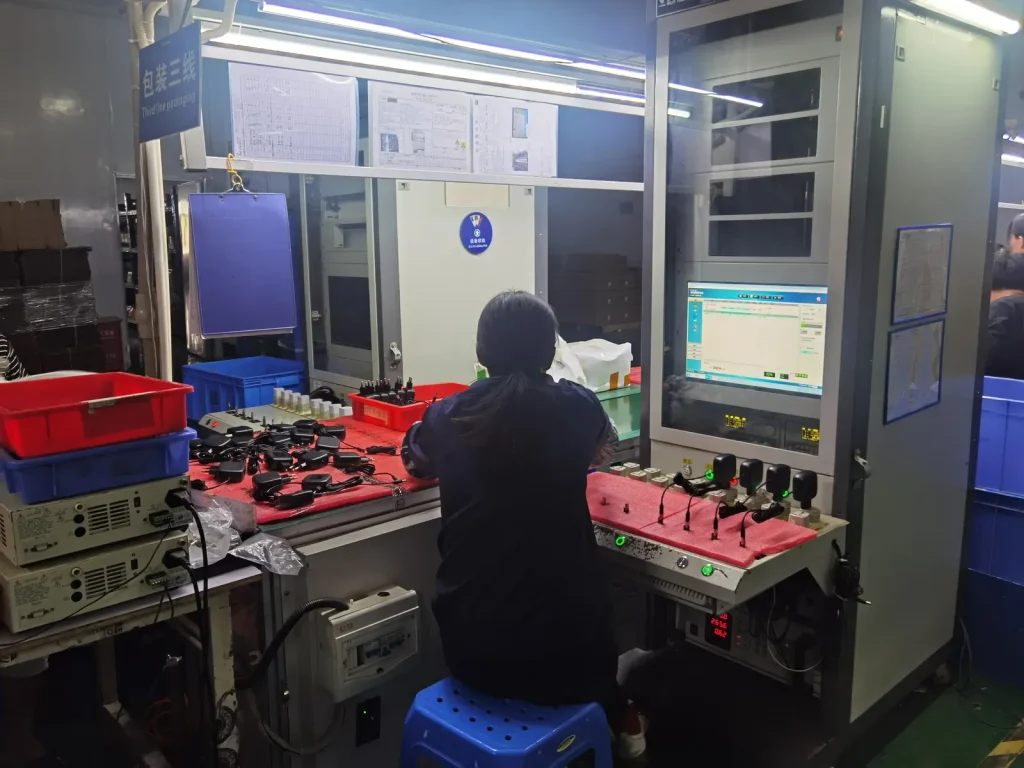
Paiyi Power: perfil de fabricação PD 3.2
A Paiyi Power é um fabricante OEM/ODM de fontes de alimentação sediado na China. Os números abaixo são dados da nossa própria fábrica, atualizados em setembro de 2026.
| Item | Paiyi Power |
|---|---|
| Quantidade mínima de pedido (MOQ) | 200 unid. por modelo |
| Capacidade mensal | Até 150.000 unid. |
| Linhas de produção | 4 |
| Funcionários | 50 |
| Lead time | 5-6 weeks |
| Inspeção pré-envio | 100% das unidades |
| Sistema de qualidade | ISO 9001 |
| Status PD 3.2 | Produtos projetados conforme a especificação USB PD 3.2, incluindo SPR AVS. Lotes de produção anteriores foram testados e certificados sob USB PD 3.1. |
Uma coisa que declaramos claramente: Paiyi Power chargers are designed to the USB PD 3.2 specification including SPR AVS, but certification status differs by SKU and by production batch, and earlier runs were certified under USB PD 3.1. Rather than make a blanket claim, we send the current test report for the exact model you are sourcing.
Frequently asked questions about USB PD 3.2
What is USB PD 3.2?
It is the revision of the USB Power Delivery specification, published by USB-IF in October 2023, that makes AVS mandatory in the 27W–100W band. It does not raise the maximum power of the standard; it changes how voltage is negotiated between charger and device.
What is the difference between PD 3.1 and PD 3.2?
Maximum power is the same (240W); the difference is that PD 3.2 extends AVS from the EPR band down into the SPR band. In PD 3.1, AVS only existed above 100W (15V–48V). In PD 3.2 it is also required between 27W and 100W, at 9V–15V or 9V–20V.
From how many watts is AVS mandatory?
Above 27W. Any source with a PDP above 27W must advertise AVS APDO in order to certify to PD 3.2. Below 27W, AVS is not required.
What is the SPR AVS voltage range?
It depends on the source rating: 9V to 15V for sources up to 45W, and 9V to 20V for sources above 45W. In both cases the adjustment step is 100mV.
Does PD 3.2 increase maximum charging power?
No. The ceiling remains 240W (48V / 5A) in EPR mode. The gain from PD 3.2 is efficiency and lower heat in the mid-power band, not raw power.
Does a PD 3.2 charger work with PD 3.0 or 3.1 devices?
Yes. PD 3.2 is backwards compatible. A PD 3.2 charger negotiates normally with PD 3.1, PD 3.0 and earlier devices; the AVS features are simply not used when the device does not support them.
Does AVS replace PPS?
No. Both modes can coexist in the same charger. PPS uses 20mV steps with active current limiting and is aimed at direct battery charging in smartphones; AVS uses 100mV steps and is designed to feed a system input rail.
Do I need USB-IF certification to sell PD 3.2 chargers?
USB-IF certification is not required by law, but it is required to use the logo, and it is what brand owners and tenders ask for as proof of conformance. For the European Union, Directive (EU) 2022/2380 on the common charger also applies, and references the IEC 62680 series.
Is there still time to certify a product to PD 3.1?
Not for new end-product submissions: according to GRL, the window for PD R3.1 V1.8 closed in September 2026. New projects need to be developed on the PD 3.2 baseline.
Are Paiyi Power chargers USB-IF certified to PD 3.2?
Paiyi Power products are designed to the USB PD 3.2 specification including SPR AVS; certification status varies by SKU and production batch, and earlier production runs were certified under USB PD 3.1. Enviamos o certificado e o laudo de teste atuais para o modelo específico que você está comprando, em vez de fazer uma afirmação generalizada.
Conclusão
USB PD 3.2 with SPR AVS is the natural evolution of fast charging: more efficient, more precise and safer across a wide range of devices.
For manufacturers and brands, it is an opportunity for technical differentiation and premium positioning. For buyers and importers, it is the chance to refresh a portfolio with products aligned to where the global market is heading.
The market has already moved. The question is no longer whether to adopt PD 3.2, but when.
Fontes e leitura complementar
Este artigo foi atualizado em setembro de 2026 usando as seguintes fontes primárias:
- USB-IF - Biblioteca de Documentos: USB Power Delivery (especificações oficiais, incl. USB PD R3.2 V1.2 de 20 de maio de 2026)
- USB-IF - Programa de Conformidade (programa de certificação e laboratórios autorizados)
- IEC 62680-1-2:2024 - a edição IEC da USB Power Delivery Specification Revision 3.2, Version 1.0
- Diretiva (UE) 2022/2380 - a diretiva do carregador comum na União Europeia
- GRL / SGS - USB PD SPEC 3.2: atualizações de especificação e pontos de teste de certificação
Leitura relacionada na Paiyi Power
- Guia de Aquisição OEM de Carregadores GaN
- PD 3.2 Adapter Manufacturer: What OEM Buyers Need to Know
- Carregador de 140W Carregando Só a 100W? As Três Causas e Como Projetar para Eliminá-las
- Requisitos do Cabo USB-C de 240W: Marcação Eletrônica, 5A e Isolação de Alta Tensão Explicados
- SPR AVS vs PPS: Qual Método de Tensão Ajustável o Seu Carregador Deve Implementar?
Paiyi Power é uma fabricante de fontes e carregadores que suporta USB PD 3.2, com personalização OEM/ODM e entrega em 5-6 semanas.
Fale com nossa equipe to discuss your PD 3.2 charger project.