

USB PD 3.2: What Changes for Manufacturers and B2B Buyers
Published: September 2026
Reading time: 5 min
Audience: OEM manufacturers, buyers, importers and brands sourcing power supplies and chargers
By Han — Paiyi Power, an OEM/ODM manufacturer of GaN chargers and external power supplies, working with international B2B customers on USB-IF certification.
Last updated: 6 September 2026.
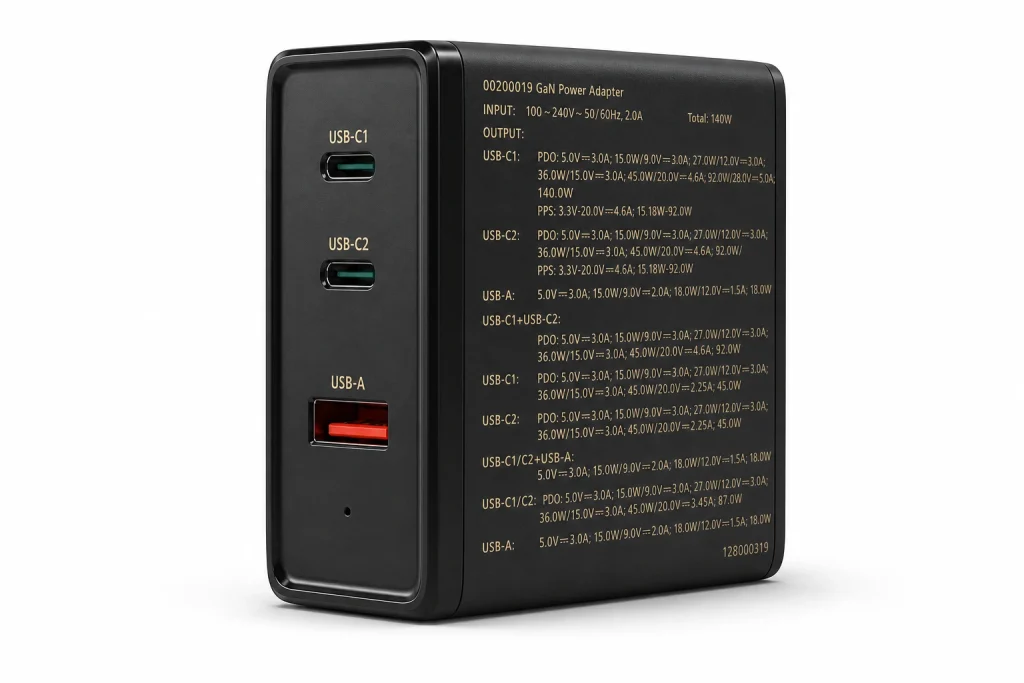
Paiyi Power 140W USB PD 3.2 SPR AVS GaN charger, designed for OEM/ODM buyers sourcing USB Power Delivery 3.2 products.
Contents
Direct answer: what changes in USB PD 3.2?
USB PD 3.2 makes AVS (Adjustable Voltage Supply) mandatory for any power source above 27W. Instead of being locked to the fixed 5V / 9V / 15V / 20V steps, the charger adjusts its output voltage in 100mV increments: 9V to 15V on sources up to 45W, and 9V to 20V on sources above 45W. Maximum power does not change — it stays at 240W in EPR. What changes is efficiency and heat, precisely in the 27W–100W band that accounts for most of the charger market.
What is USB PD 3.2?
USB Power Delivery 3.2 (PD 3.2) is the revision of the USB-IF fast-charging standard released in October 2023; the current release is USB PD R3.2 V1.2, published 20 May 2026. Its purpose is to bring to the mid-power band (27W–100W) the same efficiency benefits that previously existed only in high-power chargers above 140W.
In practice, PD 3.2 means chargers that run cooler, waste less energy and put less thermal stress on batteries — while staying compatible with older chargers and devices.
The specification is also published as an IEC standard: IEC 62680-1-2:2024 is the IEC edition of USB Power Delivery Specification Revision 3.2, Version 1.0.
USB PD 3.2 vs PD 3.1: what is the difference?
| Feature | USB PD 3.1 | USB PD 3.2 |
|---|---|---|
| Maximum power | 240W (48V / 5A) | 240W (48V / 5A) — unchanged |
| AVS available | EPR only (above 100W, 15V–48V) | Also in SPR (27W–100W) |
| SPR AVS window | Not applicable | 9V–15V up to 45W; 9V–20V above 45W |
| Adjustment step | 100mV (EPR) | 100mV (SPR and EPR) |
| Target devices | High-performance notebooks and workstations | Notebooks, tablets, smartphones and mid-power devices |
Where AVS applies in each mode (reference table)
| Mode | Introduced in | Voltage range | Step | Power range |
|---|---|---|---|---|
| Fixed PDO (SPR) | PD 1.0–3.0 | 5V / 9V / 15V / 20V | — | up to 100W |
| SPR AVS (sources up to 45W) | PD 3.2 | 9V – 15V | 100mV | 27W – 45W |
| SPR AVS (sources above 45W) | PD 3.2 | 9V – 20V | 100mV | 45W – 100W |
| EPR AVS | PD 3.1 | 15V – 48V | 100mV | above 100W, up to 240W |
| Fixed PDO (EPR) | PD 3.1 | 28V / 36V / 48V | — | up to 240W (48V / 5A) |
| PPS (SPR APDO) | PD 3.0 | from 5V | 20mV | up to 100W |
Two details that are often misread: AVS does not replace PPS (a charger may advertise both), and EPR AVS still exists in PD 3.2 — what is new is that AVS is now also required in the SPR band, below 100W.
The main difference is that PD 3.2 extends AVS to the power band that serves most of the market.
SPR AVS: the change that matters
SPR AVS (Standard Power Range Adjustable Voltage Supply) is the heart of PD 3.2.
How does it work?
Instead of fixed voltages (5V, 9V, 15V, 20V), a PD 3.2 charger adjusts its output voltage in 100mV increments within the applicable range. The device (smartphone, notebook, tablet) negotiates with the charger for the exact voltage it needs — no more, no less.
What are the benefits?
| Benefit | Practical impact |
|---|---|
| Higher energy efficiency | Less energy wasted as heat |
| Lower operating temperature | Cooler chargers and devices |
| Longer battery life | Less thermal stress on the cells |
| Faster charging | Voltage matched to what the device asks for |
| Broad compatibility | Works with PD 3.1, PD 3.0 and earlier devices |
Mandatory requirement
From PD 3.2 onward, any power source above 27W must support AVS. This is not optional — it is a requirement of the specification.
Quick reference: PD 3.1, PD 3.2, PPS and AVS
These four terms are constantly mixed up in incoming specifications, so here is the short version.
| Term | What it covers | Practical meaning |
|---|---|---|
| PD 3.1 | Introduced the extended power range above the standard band, with adjustable voltage in that range | Products above the standard power band and the higher voltage rail |
| PD 3.2 | Extended adjustable voltage into the standard power range, added a short-term peak-current field and a vendor-defined message framework | Efficiency and heat gains below the higher voltage band |
| PPS | Fine-grained programmable voltage and current, introduced with PD 3.0 | Fast-charging handsets that track battery voltage closely |
| AVS | Adjustable voltage in coarser steps across a wide range | Laptops, docks and higher-power equipment |
Two of the four are specification revisions and two are operating modes, which is exactly why they get confused.
- SPR AVS vs PPS: which adjustable mode your product should implement
- 240W USB-C cable requirements: e-marker, 5A and voltage rating
- Why a 140W charger only charges at 100W
- What PD 3.2 changes for 140W laptop chargers
We design to the PD 3.2 specification including SPR AVS. Certification status varies by SKU and production batch, and we do not claim USB-IF certification or a TID.
Opportunities for manufacturers and brands
1. The market is already moving
PD 3.2 is no longer “the future” — it is current:
- Apple released a 40W adapter with PD 3.2 SPR AVS support alongside the iPhone 17
- Baseus released a 45W charger with PD 3.2 AVS
- Huntkey released a 45W charger with PD 3.2 AVS
- Satechi released a 240W desktop charger with PD 3.2 support
- Aohai released one of the first 240W chargers with PD 3.2
2. Competitive advantage for brands
Offering chargers with PD 3.2 and SPR AVS lets a brand position itself at the front of charging technology — a clear differentiator in an increasingly crowded market.
3. Differentiation for OEM manufacturers
For manufacturers, developing PD 3.2 products means:
- Accessing a growing market of brands looking for “future-proof” products
- A technical edge over competitors still shipping PD 3.1 designs
- Meeting the USB-IF specification requirements for certification
Opportunities for buyers and importers
1. Higher value-added products
PD 3.2 chargers can be positioned as premium products with a clear technical justification — higher efficiency, less heat, better battery protection.
2. Portfolio refresh
With major brands already adopting it (Apple, Baseus and others), carrying PD 3.2 products shows your range is aligned with where the market is going.
3. Certification timing
The transition to PD 3.2 certification is under way. Sourcing products that already comply puts you ahead of the regulatory curve.
To put dates on it: USB-IF grants grace periods of 18 months for silicon and 24 months for end products, counted from each revision’s publication date. According to GRL (Granite River Labs, part of the SGS group since March 2026), a USB-IF authorised test laboratory, end products based on USB PD R3.1 V1.8 stopped being accepted for new certification in September 2026, and those based on PD R3.2 V1.0 stop being accepted in November 2026. The latest published revision is USB PD R3.2 V1.2, dated 20 May 2026.
Note: USB-IF revises grace dates periodically. Confirm the schedule with your own test lab before locking in production.
What B2B buyers should ask suppliers
- “Do your chargers support USB PD 3.2 with SPR AVS?” — This is the most important question. AVS is the heart of the new specification.
- “What AVS voltage range is supported?” — For chargers above 45W the range should be 9V to 20V; up to 45W it should be 9V to 15V.
- “Is the product USB-IF certified?” — Certification is what proves conformance to the specification, and is required in order to use the USB-IF logo.
- “Is the charger backwards compatible?” — PD 3.2 is fully compatible with PD 3.1 and PD 3.0.
- “What is the charger’s efficiency with AVS?” — AVS was designed specifically to improve efficiency.
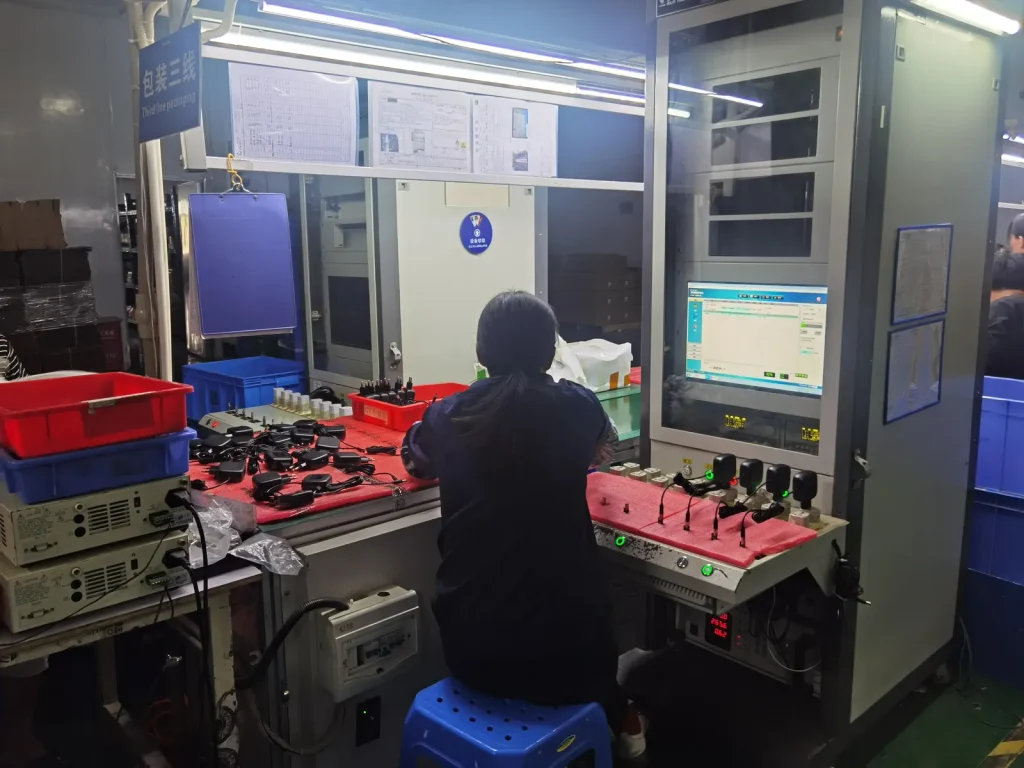
Paiyi Power: PD 3.2 manufacturing profile
Paiyi Power is an OEM/ODM power supply manufacturer based in China. The figures below are our own factory data, current as of September 2026.
| Item | Paiyi Power |
|---|---|
| Minimum order quantity (MOQ) | 200 pcs per model |
| Monthly capacity | Up to 150,000 pcs |
| Production lines | 4 |
| Employees | 50 |
| Lead time | 5-6 weeks |
| Pre-shipment inspection | 100% of units |
| Quality system | ISO 9001 |
| PD 3.2 status | Products designed to the USB PD 3.2 specification, including SPR AVS. Earlier production runs were tested and certified to USB PD 3.1. |
One thing we state plainly: Paiyi Power chargers are designed to the USB PD 3.2 specification including SPR AVS, but certification status differs by SKU and by production batch, and earlier runs were certified under USB PD 3.1. Rather than make a blanket claim, we send the current test report for the exact model you are sourcing.
Frequently asked questions about USB PD 3.2
What is USB PD 3.2?
It is the revision of the USB Power Delivery specification, published by USB-IF in October 2023, that makes AVS mandatory in the 27W–100W band. It does not raise the maximum power of the standard; it changes how voltage is negotiated between charger and device.
What is the difference between PD 3.1 and PD 3.2?
Maximum power is the same (240W); the difference is that PD 3.2 extends AVS from the EPR band down into the SPR band. In PD 3.1, AVS only existed above 100W (15V–48V). In PD 3.2 it is also required between 27W and 100W, at 9V–15V or 9V–20V.
From how many watts is AVS mandatory?
Above 27W. Any source with a PDP above 27W must advertise AVS APDO in order to certify to PD 3.2. Below 27W, AVS is not required.
What is the SPR AVS voltage range?
It depends on the source rating: 9V to 15V for sources up to 45W, and 9V to 20V for sources above 45W. In both cases the adjustment step is 100mV.
Does PD 3.2 increase maximum charging power?
No. The ceiling remains 240W (48V / 5A) in EPR mode. The gain from PD 3.2 is efficiency and lower heat in the mid-power band, not raw power.
Does a PD 3.2 charger work with PD 3.0 or 3.1 devices?
Yes. PD 3.2 is backwards compatible. A PD 3.2 charger negotiates normally with PD 3.1, PD 3.0 and earlier devices; the AVS features are simply not used when the device does not support them.
Does AVS replace PPS?
No. Both modes can coexist in the same charger. PPS uses 20mV steps with active current limiting and is aimed at direct battery charging in smartphones; AVS uses 100mV steps and is designed to feed a system input rail.
Do I need USB-IF certification to sell PD 3.2 chargers?
USB-IF certification is not required by law, but it is required to use the logo, and it is what brand owners and tenders ask for as proof of conformance. For the European Union, Directive (EU) 2022/2380 on the common charger also applies, and references the IEC 62680 series.
Is there still time to certify a product to PD 3.1?
Not for new end-product submissions: according to GRL, the window for PD R3.1 V1.8 closed in September 2026. New projects need to be developed on the PD 3.2 baseline.
Are Paiyi Power chargers USB-IF certified to PD 3.2?
Paiyi Power products are designed to the USB PD 3.2 specification including SPR AVS; certification status varies by SKU and production batch, and earlier production runs were certified under USB PD 3.1. We send the current certificate and test report for the specific model you are buying rather than making a blanket claim.
Conclusion
USB PD 3.2 with SPR AVS is the natural evolution of fast charging: more efficient, more precise and safer across a wide range of devices.
For manufacturers and brands, it is an opportunity for technical differentiation and premium positioning. For buyers and importers, it is the chance to refresh a portfolio with products aligned to where the global market is heading.
The market has already moved. The question is no longer whether to adopt PD 3.2, but when.
Sources and further reading
This article was updated in September 2026 using the following primary sources:
- USB-IF — Document Library: USB Power Delivery (official specifications, incl. USB PD R3.2 V1.2 of 20 May 2026)
- USB-IF — Compliance Program (certification programme and authorised laboratories)
- IEC 62680-1-2:2024 — the IEC edition of USB Power Delivery Specification Revision 3.2, Version 1.0
- Directive (EU) 2022/2380 — the common charger directive in the European Union
- GRL / SGS — USB PD SPEC 3.2: specification updates and certification test points
Related reading on Paiyi Power
- GaN Chargers OEM Procurement Guide
- PD 3.2 Adapter Manufacturer: What OEM Buyers Need to Know
- 140W Charger Only Charging at 100W? The Three Causes and How to Design Them Out
- 240W USB-C Cable Requirements: E-Marker, 5A and High-Voltage Insulation Explained
- SPR AVS vs PPS: Which Adjustable Voltage Method Should Your Charger Implement?
Paiyi Power is a manufacturer of power supplies and chargers supporting USB PD 3.2, with OEM/ODM customisation and 5–6 week delivery.
Talk to our team to discuss your PD 3.2 charger project.