Kiosk Power Supply Guide: Specifying Power for Kiosks, Vending Machines and Self-Service Terminals
Published: September 2026
Reading time: 8 min
Audience: kiosk and vending machine OEMs, self-service hardware brands, and procurement teams sourcing external power adapters for unattended terminals
By Han — Paiyi Power, an OEM/ODM power adapter manufacturer building custom and modified-standard supplies from 5W to 240W, from 200 pcs per model.
Last updated: 9 September 2026.
Contents
Direct answer: what power adapter does a kiosk need?
A kiosk power supply is specified by what happens when nobody is there: it must recover automatically from every fault, survive a public indoor or semi-outdoor environment, and hold continuous duty 24/7 — because a latched fault state is a machine out of service until a technician arrives. Electrically, most kiosks and self-service terminals run their compute, display and payment stacks on 12V or 24V DC external adapters (150–400W class), while vending machines keep refrigeration compressors on separate internal circuits and use the external adapter for control boards, telemetry and screens. Add locking connectors, EMC discipline next to payment terminals, and per-market certification, and you have a genuinely custom sourcing project — best served by a modified-standard ODM program from 200 pcs per model.
What unattended operation changes in the specification
Everything in a kiosk specification follows from one sentence: there is no user to reset it. That converts three adapter behaviours from nice-to-have into hard requirements:
- Automatic fault recovery: after an output short, over-temperature or input sag, the adapter must recover by itself — a latching protection that needs a power cycle is a machine dark until opening hours.
- Defined restart after outages: the kiosk must come back up in a known state after any input interruption; the adapter must not add its own quirks to that sequence.
- Continuous duty at real ambient: 24/7 ratings at the cabinet’s actual internal temperature, with the derating curve stated — not a 25°C bench number.
The same unattended logic drives our notes on battery and BMS programs and on industrial sensor power: the supply’s behaviour under abnormal conditions is the specification.
The kiosk load map
A self-service kiosk is a PC, a display, a printer, a payment terminal and a handful of actuators behind one door, and the kiosk power supply feeds every one of them. Budget every one of them, including the ones that fire simultaneously — a receipt printing while the screen brightens and the payment terminal transmits is your true peak. Check the budget table in our POS terminal power adapter guide for the payment-and-printer half of that stack.
Vending machines: the refrigeration boundary
Vending machines add a compressor, lighting and sometimes heating — those belong on the machine’s internal power architecture, not on the external adapter. The external supply typically feeds the control board, telemetry module, touchscreen and payment reader (a 12V or 24V unit from 60W to 200W depending on the stack). Drawing the boundary early matters: if procurement assumes the external adapter will also carry refrigeration, the project inherits compressor inrush currents and a different certification picture. Specify what the adapter feeds, and let the machine builder own the rest.
Environment: temperature, dust and placement
Kiosks live in lobbies, transit platforms, petrol stations and street fronts. Inside the cabinet the adapter itself usually sits in a sealed, unventilated compartment — an IP20 adapter inside a well-sealed cabinet is normally the right answer, with the cabinet carrying the ingress protection (the logic from our industrial sensor guide applies unchanged). The specification work is thermal and electrical: ambient range at the mounting point, condensation cycles for street-front machines, dust on any forced-ventilated variant, and input immunity for electrically noisy public infrastructure. The kiosk power supply specification should state all of these explicitly.
Sizing: continuous duty plus everything switching at once
Size from the load map: sum the continuous draws, add the largest simultaneous event (printer + display brightening + payment transmit + lock solenoid), then apply 30–50% headroom. Verify two adapter behaviours against that peak: transient recovery (the rail must stay in spec through the event) and continuous rating at the cabinet’s internal ambient. Night-time is not a rest period for a vending machine’s telemetry either — standby and no-load draw belong in the spec for machines that sit mostly idle.
Cabling inside a big cabinet
Kiosks are tall: the adapter often sits at the bottom while the screen and payment head are a metre or more up. Cable runs of 1–2 m at 12V drop real voltage — calculate it, thicken the conductor, or use remote sense / a locally regulated rail, exactly as described in our sensor power guide. Use screw-locked or terminal-block connections inside the cabinet; a plain barrel hanging on gravity is a service call waiting for a door slam.
EMC and payment terminals in public spaces
The payment head and the power adapter share a cabinet with printers, solenoids and fluorescent or LED lighting. Specify EMC to the industrial generic standards (IEC 61000-6-2 / 61000-6-4) and test with the real kiosk powered up — the same discipline as our POS terminal power guide, where the contactless reader sits centimetres from the adapter. Public infrastructure also sees surges from signage motors, HVAC and grid events, so input surge immunity belongs in the spec.
Certification, efficiency and market access
Base layer IEC/EN 62368-1 + EMC (CE / FCC) factory-held, then the market layers — UKCA, INMETRO (+ANATEL where applicable), PSE, KC, RCM, BIS, SII — with per-model lead times as mapped in power adapter certification by country. Efficiency requirements (DOE VI / CoC Tier 2 / ErP) apply to the adapter as an external supply — and in a 24/7 machine, no-load and standby draw are operating costs, not just compliance lines.
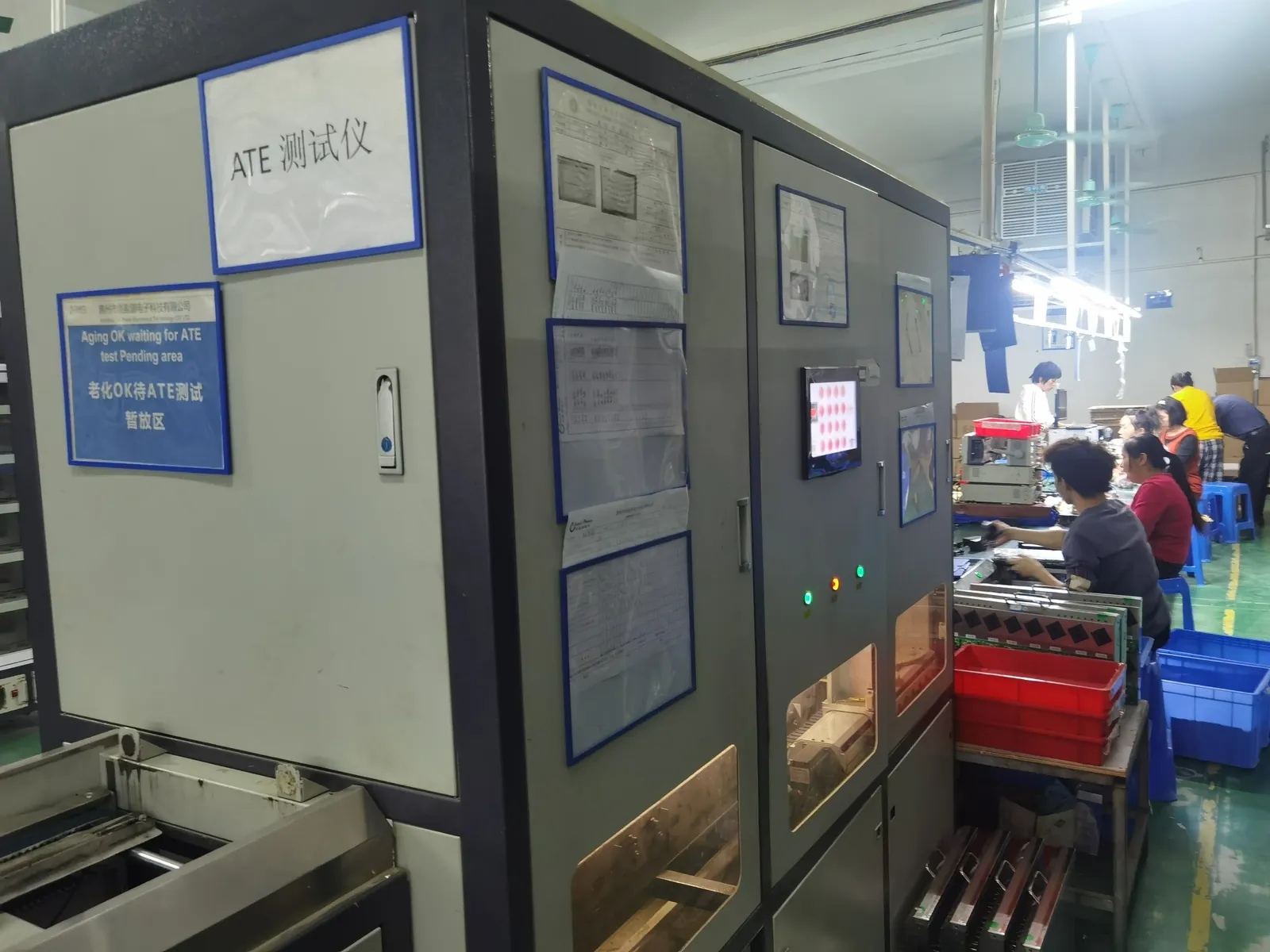
Kiosk power supply specification table
| Parameter | Typical for a kiosk / vending control stack | Note |
|---|---|---|
| Output | 12V or 24V DC, 150–400W class | Match the compute stack; refrigeration stays on machine power |
| Recovery behaviour | Automatic after OCP/OTP/input events | No latch states on an unattended machine |
| Hold-up & restart | Hold-up per design; auto-restart after outage | Transaction and boot integrity |
| Continuous rating | 24/7 at cabinet internal ambient, curve stated | Not a 25°C bench figure |
| Standby / no-load draw | Low no-load power (≤0.21W class) | Matters for idle-heavy vending machines |
| EMC | IEC 61000-6-2 / 61000-6-4 + surge immunity | Tested with the real kiosk running |
| Connections | Screw-lock barrel or terminal blocks | Gravity-hung barrels are service calls |
Frequently asked questions
What voltage does a kiosk power supply use?
12V and 24V DC dominate kiosk and vending control stacks, with higher-power compute builds drawing 24V at 8–15A. Match the adapter to the machine’s power architecture, and keep refrigeration out of the adapter’s scope.
Does the external adapter power the vending machine’s refrigeration?
No — refrigeration compressors belong on the machine’s internal power architecture. The external supply feeds control, telemetry, screens and payment; draw that boundary in the specification before you quote.
Why does our kiosk reboot at night when nothing is running?
Look for grid events, shared circuits with HVAC or signage, and protection behaviour. An adapter that latches into a fault state overnight leaves the machine dark until morning — specify automatic recovery and log the input events.
What IP rating does a kiosk adapter need?
Usually none on the adapter itself: inside a sealed cabinet an IP20 unit is correct, and the cabinet carries the ingress rating. Only externally mounted adapters need IP65 or better.
Can one adapter power the kiosk and the payment terminal?
Yes, within the combined peak budget — the payment head is just another load, with the EMC proximity notes from our POS power guide.
What certifications does a kiosk adapter need?
CE/FCC as the base, then the destination-market layers (UKCA, INMETRO, PSE, KC, RCM, BIS, SII) — scopes and lead times in certification by country.
What MOQ and lead time apply?
From 200 pcs per model at Paiyi Power, 5–6 weeks to first production after sample approval. Modified-standard builds usually need no tooling — see our low-MOQ guide, and evaluate the first samples with our sample evaluation checklist.
How do we protect the agreement terms on a kiosk program?
Tooling ownership, NDA, change control and repeat-run commitment in writing — the five clauses in our OEM agreement guide apply to kiosk programs exactly as to any custom adapter.
Sources
- IEC — 62368-1 safety and 61000-6 series EMC standards
- EMVCo — Contactless payment specifications
- U.S. DOE — External Power Supply efficiency (Level VI)
Related on this blog: POS terminal power adapter, industrial sensor power supply adapter, power adapter OEM agreement guide.