Outdoor Power Supply OEM: IP65 vs IP67, Potting and Surge Protection for Exposed Installations
Published: September 2026
Reading time: 10 min
Audience: OEMs and integrators installing power supplies outdoors — CCTV, access control, signage, lighting, telecom and industrial equipment — and procurement teams writing an outdoor environmental specification
By Han — Paiyi Power, an OEM/ODM power supply manufacturer and outdoor power supply OEM partner building custom and modified-standard supplies from 5W to 240W, from 200 pcs per model.
Last updated: 15 September 2026.
Contents
Direct answer: what makes a power supply outdoor-rated?
An outdoor power supply is defined by four things: an enclosure that survives the weather (IP65 or better, and often potting), protection against condensation rather than just rain, a temperature rating that accounts for solar gain, and surge immunity sized for a long exposed cable run. The IP rating is the starting point, not the whole answer.
For any team choosing an outdoor power supply OEM partner, the specifications that decide whether the installation survives five years are condensation control, thermal derating at real cabinet temperature, and surge protection — not the number after “IP”.
Most outdoor failures are not drowned. They are corroded, cooked or condensing. At Paiyi Power we build these from 200 pcs per model, with samples in about a week and first production in 5–6 weeks after approval.
Why outdoor power is its own discipline
An indoor supply fails when a component fails. An outdoor supply fails for reasons that have almost nothing to do with electronics. Four of them dominate:
- Weather is seasonal, not constant. A design that survives a rainy week may fail after two summers of UV and thermal cycling.
- Temperature swings drive moisture. Every heating and cooling cycle moves air and water vapour in and out of the enclosure; where it condenses is where the failure begins.
- Runs are long and exposed. A cable that climbs a pole or crosses a car park collects transients that an indoor run never sees.
- Replacements are expensive. The service call to a roadside or rooftop unit usually costs more than the supply, which changes what “good enough” means.
That is why outdoor power is specified on environment first and watts second.
The IP code, decoded
The IP code comes from IEC 60529 and has two digits: the first covers solids and dust, the second covers water. Reading it properly prevents most specification mistakes.
- First digit (solids). 0 to 6, where 6 means dust-tight. Outdoor equipment usually wants 6, because dust plus moisture makes a conductive paste.
- Second digit (water). 1 to 9K. The common outdoor values are 5 (water jets), 6 (powerful water jets), 7 (temporary immersion) and 8 (continuous immersion, with depth and duration set by the manufacturer).
- What the code does not cover. Condensation, ageing, UV, corrosion and impact are all outside the standard’s scope — and all of them matter outdoors.
- It is tested on new samples. A rating says nothing about how the same unit behaves after three years of sun on its gasket.
Taking the code at face value and stopping there is the single most common outdoor specification error.
IP65 vs IP66 vs IP67
These three are routinely treated as interchangeable. They are not, and the difference explains a lot of field surprises.
| Rating | Water test | Practical meaning outdoors |
|---|---|---|
| IP65 | Water jets, low pressure | Fine in a sheltered cabinet; not immersion-rated |
| IP66 | Powerful water jets | Survives hosed-down and driven-rain environments |
| IP67 | Temporary immersion, typically 1 m for 30 minutes | Survives a flooded pit; may still be penetrated by a high-pressure jet |
| IP68 | Continuous immersion, depth and time set by the maker | For buried or permanently submerged equipment; read the stated depth |
The counter-intuitive part: IP67 is not automatically better than IP66. Immersion and jet resistance are different tests, and a unit rated for immersion can still take water from a pressure washer aimed at a gland.
Potting, conformal coating or sealed enclosure
Once the enclosure is sealed, the question becomes what protects the electronics inside it — and the three answers behave very differently.
| Approach | Strength | Trade-off |
|---|---|---|
| Full potting | Removes the internal air volume entirely; best condensation and vibration resistance | Not reworkable; adds weight and cost; changes thermal behaviour |
| Conformal coating | Protects the board against condensation and contamination; cheaper; reworkable | Leaves an air volume that can still condense; coverage discipline matters |
| Sealed enclosure only | Lowest cost; adequate in a sheltered cabinet | Gaskets age and crack; the cable entry is the usual leak path |
The practical rule: conformal coating for sheltered outdoor, potting for exposed outdoor. Choose the potting compound deliberately too — silicones stay flexible across temperature, while rigid epoxies can stress components during thermal cycling.
Condensation: the failure ratings do not prevent
This is the outdoor failure that no IP rating addresses, and it accounts for a large share of field returns.
- The mechanism. A sealed enclosure still exchanges air through its cable entry and any imperfect seal as it heats and cools daily. Warm, moist air is drawn in; when the enclosure cools at night, the moisture condenses on the coldest surface — often the metal parts of the board.
- Why sealing harder is not the only answer. A truly sealed unit still breathes a little, and a poorly sealed one breathes a lot. Removing the air volume (potting) or managing the pressure (a breather membrane) addresses the cause rather than the symptom.
- Breather membranes and drains. A hydrophobic breather equalises pressure without admitting liquid water; a drain lets any condensate leave. On anything with a large internal air volume, oriented drainage is worth designing in.
- Thermal cycles test it. The question to ask is not “what is the IP rating”, but “what is the IP rating after thermal cycling and ageing”.
If one sentence could summarise outdoor reliability, it would be: the enemy is not rain, it is the daily breathing cycle.
Thermal: solar gain and derating
An outdoor enclosure carries two heat loads that indoor equipment never sees: its own losses and the sun.
- Solar gain is significant. A dark, sealed cabinet in direct sun can run 15–25 °C above ambient air temperature, which turns a 35 °C summer day into a 55 °C internal condition.
- Rate at cabinet temperature, not ambient. Ask for the continuous rating with a derating curve at the expected internal temperature, not a benchtop figure.
- Capacitor life is the limiter. A 105 °C rated electrolytic lasts several times longer than an 85 °C part at the same internal temperature, which is where long service life actually comes from. The mechanism is covered in why power adapters fail.
- Potting cuts both ways. It conducts heat away from components but removes convection; for high-power designs the thermal path has to be designed rather than assumed.
The honest consequence: a 60 W indoor supply is not a 60 W outdoor supply. Derating is the specification, not a safety margin.
Surge and lightning
Outdoor runs are antennae. Long cables on poles or across open ground collect transients from nearby strikes and switching events, and the supply is often the first component in their path.
- State the level. Surge immunity is specified in the IEC 61000-4-5 family; ask for the test level (for example 1 kV line-to-line and 2 kV line-to-ground) rather than the phrase “surge protected”.
- Coordinate, do not replace. The supply’s internal protection is the last line of defence. Long outdoor runs still want a proper surge protective device at the building or cabinet entry.
- Decide the failure mode. Specify whether the supply should fail open after a large event, and whether that is acceptable for your service model. Some installations prefer a sacrificial unit; others need the run to stay live.
This is the same discipline we describe for CCTV camera power supplies and for gated entry in access control power supplies.
UV, salt air and corrosion
Three environments quietly shorten outdoor life, and none of them is captured by an IP number.
- UV. Sunlight embrittles the wrong plastics and chalks standard PVC cable jackets within a couple of seasons. Ask for UV-stabilised enclosure material and UV-resistant cable jacketing.
- Salt air. Coastal installations corrode fasteners, terminals and any exposed metal. Stainless or properly coated hardware matters more here than in any other environment.
- Chemical exposure. Chlorinated pool plant rooms, agricultural sites and some industrial areas attack seals and coatings that would be fine elsewhere. Say so in the specification, because it changes the material choice.
The general principle: outdoor materials are selected for an environment, not for a category.
Connectors, glands and strain relief
Cable entries cause more outdoor water ingress than the enclosure itself, because a seal is only as good as its weakest compression point.
- Match the gland to the cable. A gland rated IP68 on a cable thinner than its seal range leaks immediately. Specify the cable diameter and the gland range together.
- Downward-facing entries. Where possible, route cables so water cannot run along them into the gland, and add a drip loop.
- Locking and strain relief. Outdoor connectors should lock, seal and resist a pulled cable; a moulded strain relief plus a defined bend radius removes the most common intermittent fault.
- Sealed mating connectors. If the output connector is exposed, specify an IP-rated mated pair rather than a standard barrel, which is not a sealed interface.
Most “the unit leaked” claims turn out to be “the cable entry leaked”.
Where the supply actually lives
The same product behaves differently in five common outdoor locations, and the specification should name one.
- Inside a sheltering cabinet. The mildest case; IP65 plus conformal coating is often sufficient.
- On a pole or soffit. Full sun and driven rain; potting plus IP66 or better, with the thermal derating applied.
- In a pit or vault. Occasional flooding; IP67 or IP68 and drainage, because immersion is a realistic event.
- Buried or ducted. Permanent moisture and ground movement; IP68 with the stated depth, plus mechanical protection.
- In a plant room or tunnel. Corrosive atmosphere and heat rather than rain; material selection dominates.
Naming the location turns a vague outdoor request into an engineering brief.
Certifications and what to ask for
Outdoor supplies need the usual safety and EMC marks plus environment-specific evidence:
- Safety: IEC/EN 62368-1 for the safety of the supply itself, with the appropriate wet or damp location listing where the market requires one.
- Ingress: the IP code per IEC 60529, with the test conditions actually stated. Note that NEMA enclosure types used in North America are related but not equivalent — do not translate an IP number into a NEMA type without checking the definitions.
- EMC and surge: FCC Part 15 in the US, and the IEC 61000-4 series for immunity, with the surge level declared.
- Corrosion: salt-spray testing to standards such as ISO 9227 is the usual evidence for coastal or marine installations.
We certify per model and per market rather than claiming one certificate covers everything; certification by country explains which schemes transfer and which need local registration.
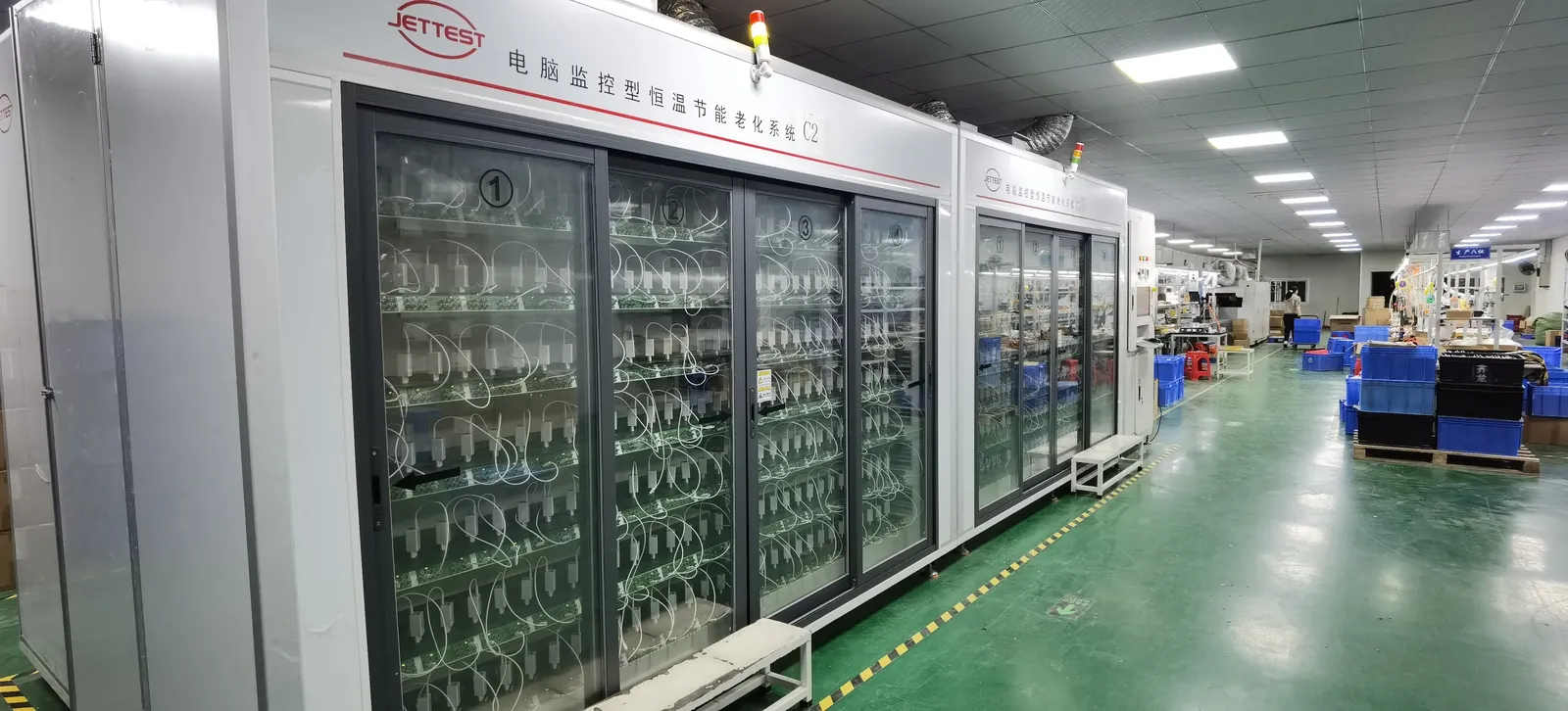
Outdoor power specification table
| Parameter | Typical for outdoor installations | Note |
|---|---|---|
| Ingress protection | IP65 sheltered; IP66 exposed; IP67/IP68 for pits and burials | IP67 is not automatically better than IP66 |
| Board protection | Conformal coating for sheltered; full potting for exposed | Potting removes the air that condenses |
| Thermal | Rating at 50–60 °C internal with derating; 105 °C capacitors | Solar gain adds 15–25 °C to a dark cabinet |
| Surge | IEC 61000-4-5 with the level declared, coordinated with an external SPD | Internal protection is the last line, not the only one |
| Materials | UV-stabilised enclosure; UV-resistant cable jacket; stainless hardware in coastal sites | Standard PVC chalks and cracks |
| Cable entry | Gland matched to cable diameter, downward facing, with a drip loop | The most common ingress path |
| Standards | IEC 60529 for IP, IEC/EN 62368-1 for safety, ISO 9227 for salt spray | NEMA types are related, not equivalent |
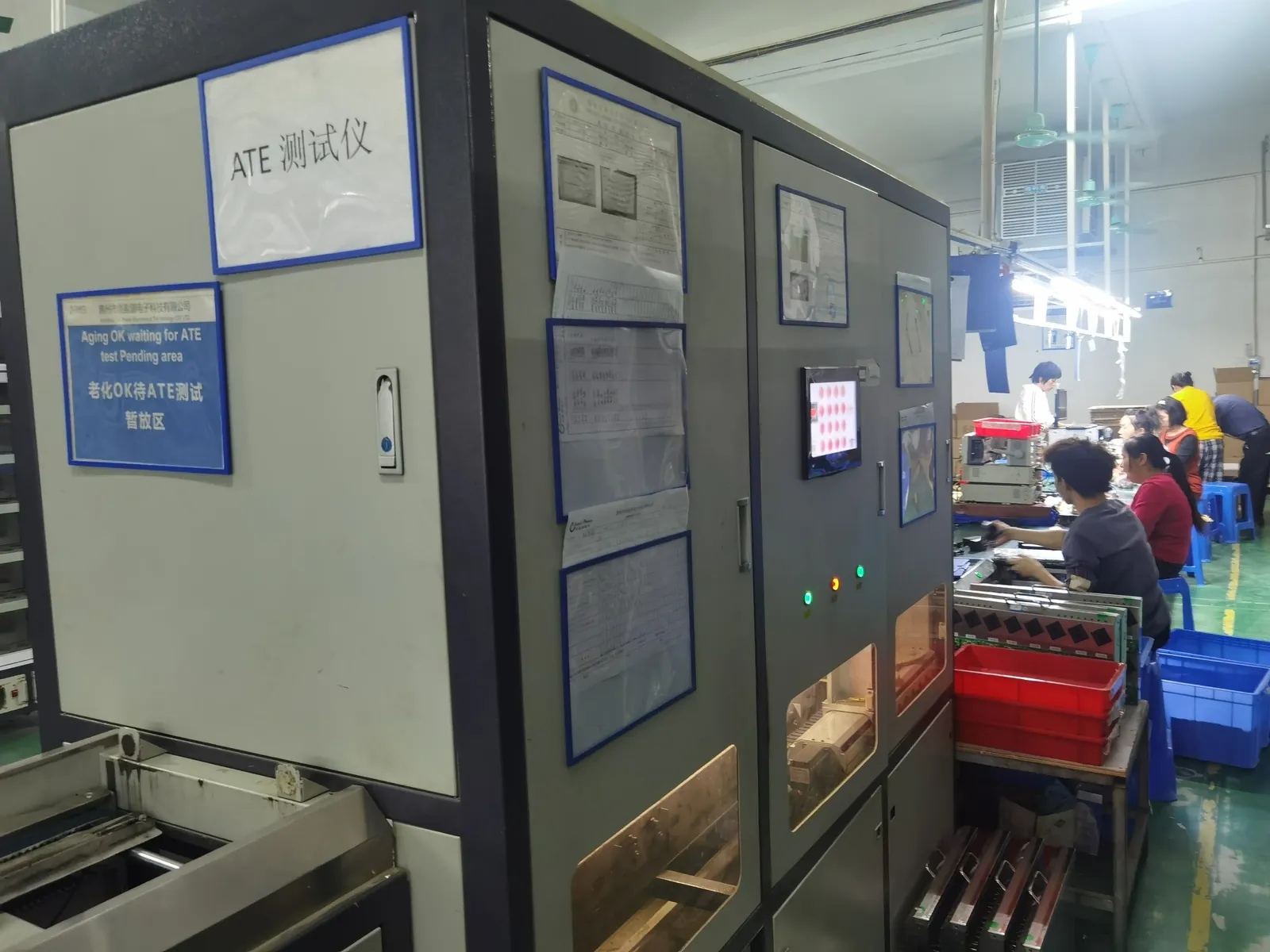
| Reliability | 100% ATE + burn-in; written change control | A silent change can alter sealing or thermal behaviour |
Frequently asked questions
What IP rating does an outdoor power supply need?
IP65 in a sheltered cabinet, IP66 for exposed positions, and IP67 or IP68 for pits, vaults and buried runs. Choose by where the unit physically sits, not by the equipment it powers, and remember that the rating describes a new sample.
Is IP67 waterproof enough for outdoor use?
For immersion, yes; for a pressure washer aimed at a gland, not necessarily. IP66 and IP67 test different things, so an immersion-rated unit is not automatically better against jets — and neither rating addresses condensation.
Potting or conformal coating — which should I choose?
Conformal coating for sheltered outdoor use, full potting for exposed positions. Potting removes the internal air volume that condenses and adds vibration resistance, at the cost of reworkability, weight and a change in thermal behaviour.
Why do outdoor supplies fail even when they are IP67?
Usually condensation, heat or surge — none of which the IP code covers. A sealed enclosure still breathes through its cable entry as it cycles daily, and solar gain can push the internals far above ambient. Specify potting, derating and surge levels, not just a rating.
How hot does an outdoor enclosure actually get?
A dark, sealed cabinet in direct sun can run 15–25 °C above ambient air temperature. On a 35 °C day that is a 55 °C working environment, which is why the continuous rating must be quoted at cabinet temperature with a derating curve.
What surge rating should I specify?
Declare the IEC 61000-4-5 test level explicitly, typically 1 kV line-to-line and 2 kV line-to-ground for exposed outdoor runs, and coordinate it with an external surge protective device. The supply’s internal protection is the last line of defence, not the only one.
How do I handle cable entries and connectors outdoors?
Match the gland to the cable diameter, face entries downward, add a drip loop, and use sealed mating connectors rather than standard barrels. A gland outside its seal range leaks immediately, and cable entries cause most water ingress claims.
Which certifications should an outdoor supply have?
IEC/EN 62368-1 for safety, an IP rating tested to IEC 60529 with conditions stated, FCC Part 15 for EMC markets, and salt-spray evidence such as ISO 9227 for coastal sites. An outdoor power supply OEM should certify per model and market rather than claim one universal certificate.
What MOQ and lead time apply for custom outdoor power supplies?
From 200 pcs per model at Paiyi Power, with samples in about a week and first production 5–6 weeks after sample approval. Fix the ingress, potting and derating requirements before tooling; use our sample evaluation checklist and the OEM agreement guide for change control.
Sources
- IEC — 60529 IP codes, 62368-1 safety, 61000-4-5 surge immunity
- UL — safety certification and wet/damp location listings
- NEMA — enclosure types (4, 4X, 6P) and their relation to IP
- ISO — 9227 salt spray testing for corrosion resistance
- FCC — Part 15 rules (Class A / Class B digital devices)
Related on this blog: CCTV camera power supply OEM, access control power supply OEM, digital signage power supply OEM, industrial sensor power supply adapter.