Digital Signage Power Supply OEM: Specifying Power for Commercial Displays, Video Walls and Outdoor Screens
Published: September 2026
Reading time: 9 min
Audience: digital signage integrators, display brands, media-player and LED-wall OEMs, and procurement teams sourcing external power supplies for always-on commercial screens
By Han — Paiyi Power, an OEM/ODM power adapter manufacturer and digital signage power supply OEM partner building custom and modified-standard supplies from 5W to 240W, from 200 pcs per model.
Last updated: 15 September 2026.
Contents
Direct answer: what power supply does digital signage need?
Most digital signage runs either from AC mains inside the display or from an external DC supply feeding a media player, a small display or an LED tile — typically 12V, 19V, 24V or 48V, sized for continuous duty at 50 °C rather than for a peak wattage on a datasheet. For any team choosing a digital signage power supply OEM partner, the specification that decides whether screens stay on for years is continuous rating at real enclosure temperature, part-load efficiency and heat management — not the number printed on the front of the box.
Size for continuous duty, keep the supply cool enough to last, and treat efficiency as a fleet operating cost rather than a compliance checkbox. At Paiyi Power we build these from 200 pcs per model, with samples in about a week and first production in 5–6 weeks after approval.
Why signage power is its own discipline
A display that is switched off most of the day is a different product from a display that is on for sixteen hours in a retail window. Four things make signage power distinct:
- Duty cycle: commercial signage commonly runs 16–24 hours a day at high brightness. A supply specified for intermittent use is a warranty claim waiting to happen.
- Thermal reality: the supply usually lives inside a thin, sealed, fanless enclosure behind a hot panel. Its own heat plus the panel’s heat plus the room’s heat arrive at once.
- Fleet economics: one signage programme can be hundreds or thousands of screens. Every watt of loss is multiplied by both electricity cost and by heat that shortens life.
- Service cost: a failed supply behind a menu board or a roadside screen costs far more to replace than the supply itself, so reliability and connector choice matter more than unit price.
That fleet logic is why signage buyers increasingly specify one qualified platform across a product family rather than re-quoting every model — the same reasoning behind OEM versus ODM versus private label sourcing decisions.
Where the external adapter actually goes
This is the part most guides get wrong, so it is worth being specific about the boundary. In a typical installation:
- Large commercial displays (roughly 43″ and up) usually take AC mains directly through an IEC inlet and contain their own power supply. You are not buying an external adapter for them.
- Media players and signage controllers — the small boxes driving those displays — almost always use an external DC adapter, commonly 12V or 19V.
- Small displays, shelf-edge and e-paper panels often run on 12V/24V DC or PoE.
- LED walls and tiles are fed by high-current supplies (5V, 12V or 24V) or a 48V distribution bus, often open-frame rather than a cased adapter.
Knowing which of these you actually ship prevents the most common quoting error in this category: asking for an adapter for a display that does not use one. It is the same boundary discipline we describe for network equipment power supplies.
The voltage landscape: 12V, 19V, 24V and 48V
Four rails dominate, and the choice is usually set by the load and the cable run rather than by preference:
- 12V — common for media players and small panels. Cheap and universal, but the worst choice for long runs because cable losses are large relative to a small voltage.
- 19V — widely used by media players and small-format PCs-class hardware, often a barrel or a pluggable connector.
- 24V — the workhorse for LED tiles and larger panels; halves the current for the same power and makes long cable runs practical.
- 48V — used for higher-power LED walls and distributed power architectures, and the basis of PoE for networked panels.
The practical rule: the higher the rail, the farther you can run power and the thinner the copper can be — which is exactly why large LED walls distribute at 48V rather than 12V.
Continuous rating, not peak rating
Signage is a continuous-load application, and the datasheet number that matters is the one at temperature — not the headline peak. Three specification lines carry most of the reliability:
- Continuous rating at a defined ambient. Demand a rating at 40–50 °C with a derating curve, because a signage enclosure is not a laboratory bench.
- Derating curve, stated. A supply rated 60 W at 25 °C may be a 40 W supply at 50 °C. If the curve is not published, assume the worst.
- Capacitor temperature rating. Electrolytics are the usual life limiter; a 105 °C part lasts several times longer than an 85 °C part at the same internal temperature. The mechanism is covered in why power adapters fail.
A supply that is correct on peak wattage and wrong on continuous rating is the single most common cause of early signage failures.
How brightness and size drive the load
Display power scales with both area and brightness, which is why two screens of the same diagonal can have very different supply needs. Brightness roughly drives power in proportion, and a bright outdoor panel can draw several times an indoor unit of the same size:
| Screen / load | Typical brightness | Indicative continuous power | Note |
|---|---|---|---|
| Indoor menu board, 32–43″ | 350–500 nits | 50–120 W | Often a media player on 12V/19V |
| Retail window display, 55–65″ | 500–700 nits | 130–250 W | Sun load adds heat, not power, to the supply |
| Outdoor panel, 55–75″ | 2,500–5,000 nits | 300–800 W | High-current supply; thermal design dominates |
| LED tile wall (per m²) | Varies with pitch | 200–600 W/m² peak | Size for inrush and content-dependent peaks, not averages |
Figures are indicative and vary widely by panel technology, content and drive settings; always work from the panel and controller datasheets. The practical consequence: content matters. A bright, high-motion retail loop can pull far more than the same screen showing a dark menu — size for the worst realistic content, not the average.
Thermal design in a thin, sealed enclosure
A signage supply usually sits in a thin, sealed box behind a hot panel with no fan. That combination forces three decisions:
- Convection, not airflow. Without a fan, heat leaves through the enclosure surface. That is a reason to specify better efficiency and a cooler-running topology rather than a bigger supply.
- Vented versus sealed. Vents help heat but admit dust and, in food-service or outdoor cabinets, moisture. For sealed enclosures, derate more and prefer higher-temperature capacitors.
- Proximity to the panel. A supply mounted against the back of a panel sees the panel’s heat on top of its own. Physical separation, or a supply with margin, matters more than the datasheet ambient suggests.
Cooler is not a comfort feature. It is the difference between a five-year life and a two-year life.
Outdoor screens: the double thermal load
Outdoor signage carries a thermal load that indoor units never see: its own waste heat plus solar gain on a sealed, usually dark enclosure in direct sun. In practice that means:
- Rate for the hottest hour, not the average day. A cabinet that measures 35 °C in the morning can exceed 60 °C at midday in summer.
- Ingress protection where the supply lives. IEC 60529 defines the IP codes; a sealed outdoor supply generally wants IP65 or better, and often potting rather than conformal coating to remove internal air that can condense.
- UV and cable jackets. Outdoor cables need UV-resistant jacketing; standard PVC chalks and cracks within a couple of seasons in direct sun.
This is the same discipline we describe for outdoor camera and sensor installations in CCTV camera power supplies, and it is worth settling before tooling rather than after the first summer.
Efficiency at fleet scale
Efficiency is a compliance requirement and a genuine operating cost in this category, because the load never stops. Two numbers matter more than the headline:
- No-load and part-load efficiency. A signage supply often idles at a fraction of its rating overnight; poor light-load efficiency is paid for continuously, and it shows up as heat inside the enclosure.
- Fleet arithmetic. Five hundred supplies each wasting 0.5 W burn 250 W continuously, plus the cooling to remove it. At thousands of screens this is a real electricity line.
Higher efficiency also means less heat, which means longer capacitor life — the two goals point the same way, which is rare and convenient.
Connectors, cable runs and voltage drop
Signage installations are full of long, thin cable runs to a panel or a tile, and that is where voltage drop returns. Two practical rules:
- Barrel versus locking versus terminal. Barrel connectors are fine for bench work but come loose in a vibrating cabinet; installed signage wants locking connectors or terminal blocks, and a defined strain relief.
- Gauge over distance. At 12V, drop over 20 m of thin cable can exceed 10% and take a panel below its input window. Either shorten the run, move to 24V/48V, or specify thicker copper — oversizing the supply does not fix drop.
State the cable gauge in the installation manual, not just the supply rating; that one line prevents a category of field calls.
Reliability and serviceability
Because replacement is expensive, signage buyers should specify reliability and serviceability together:
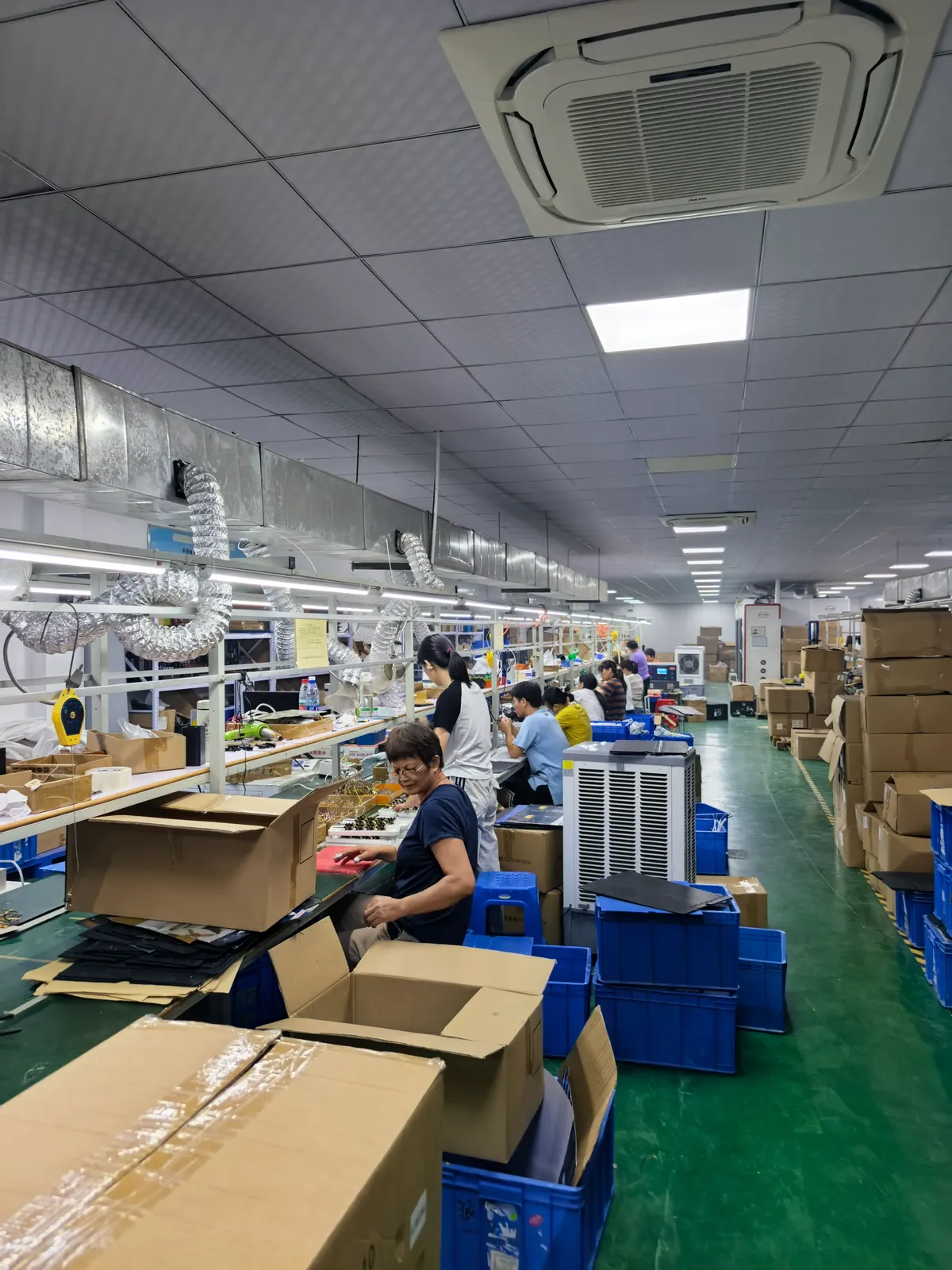
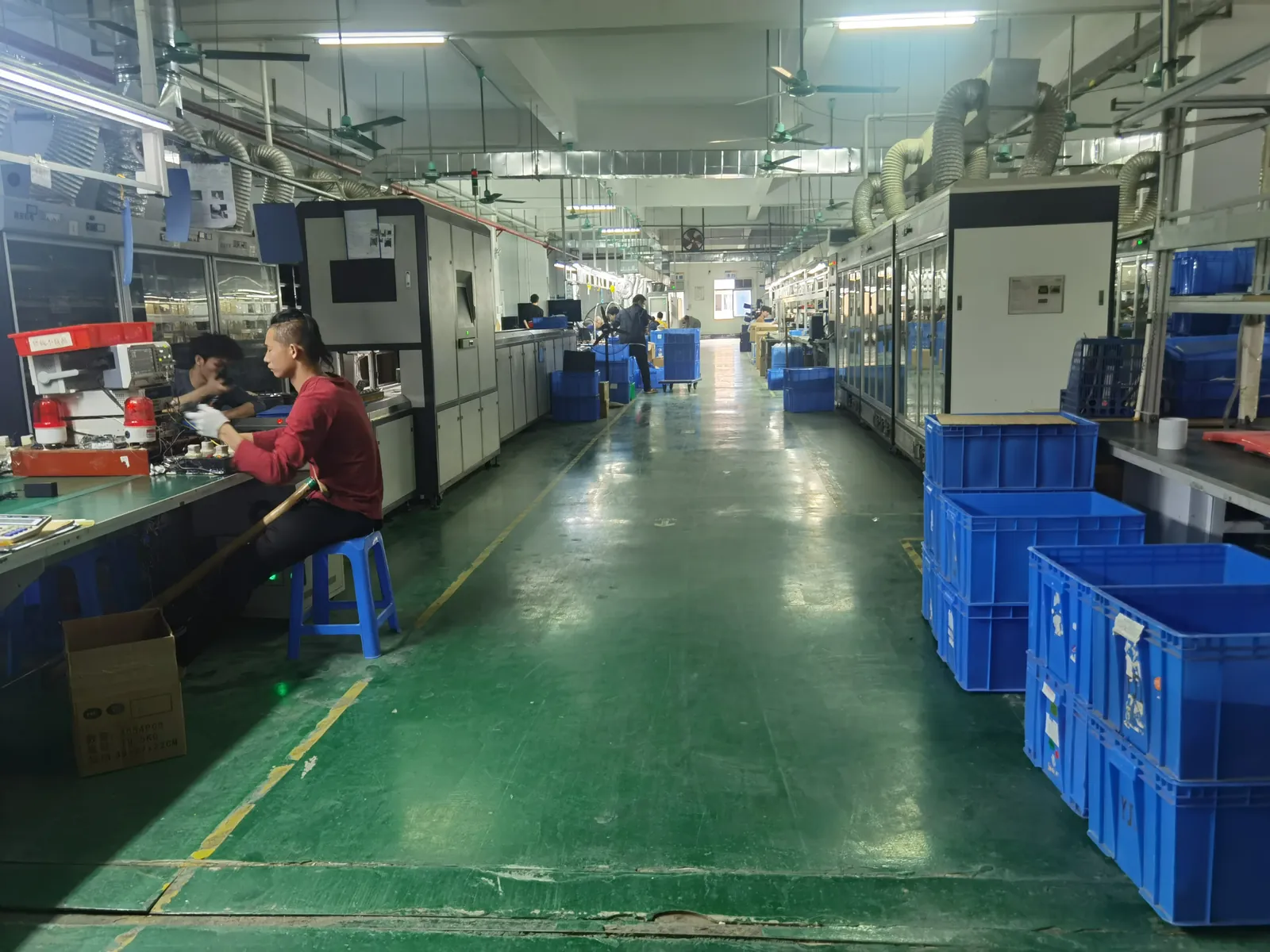
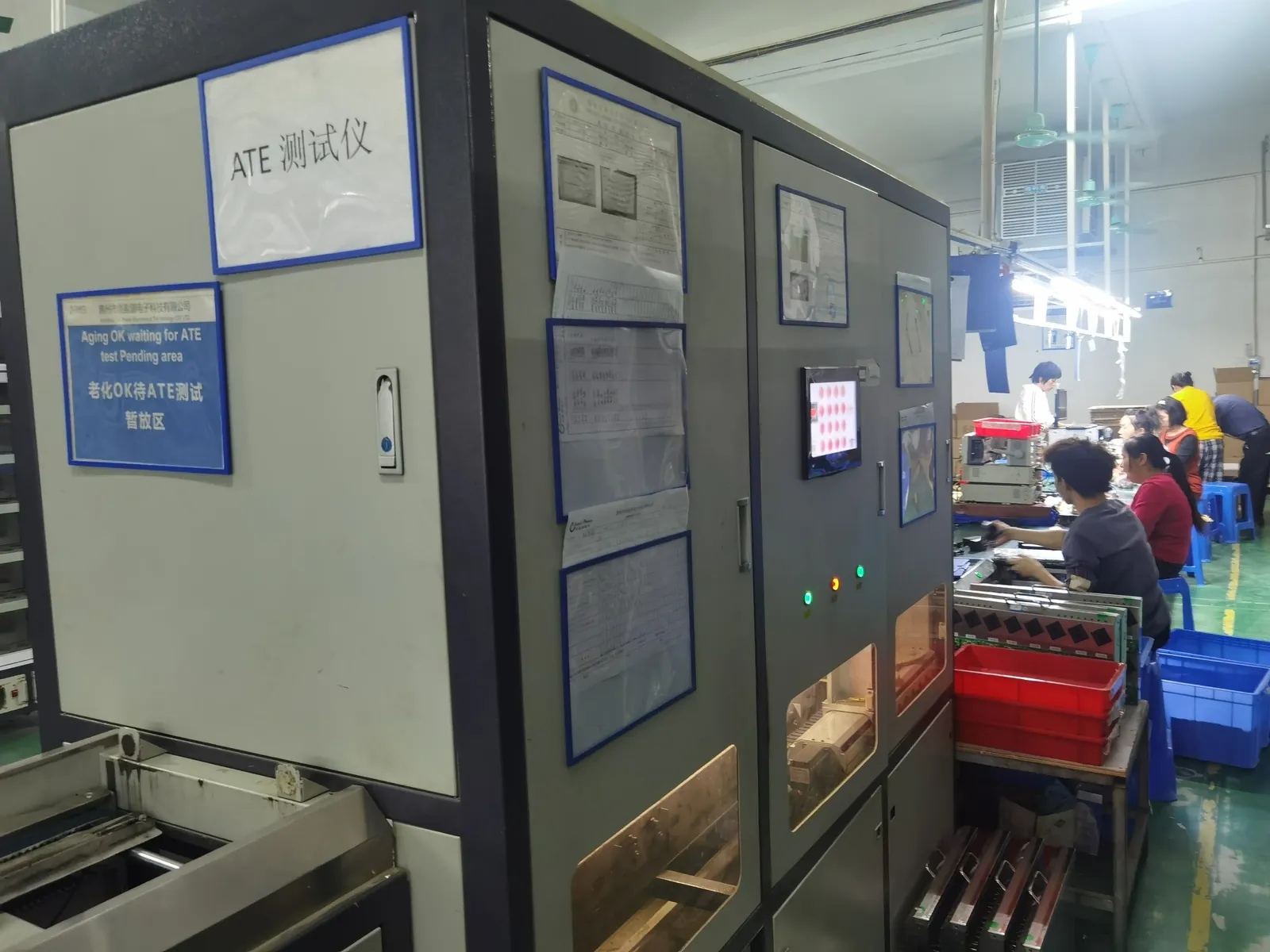
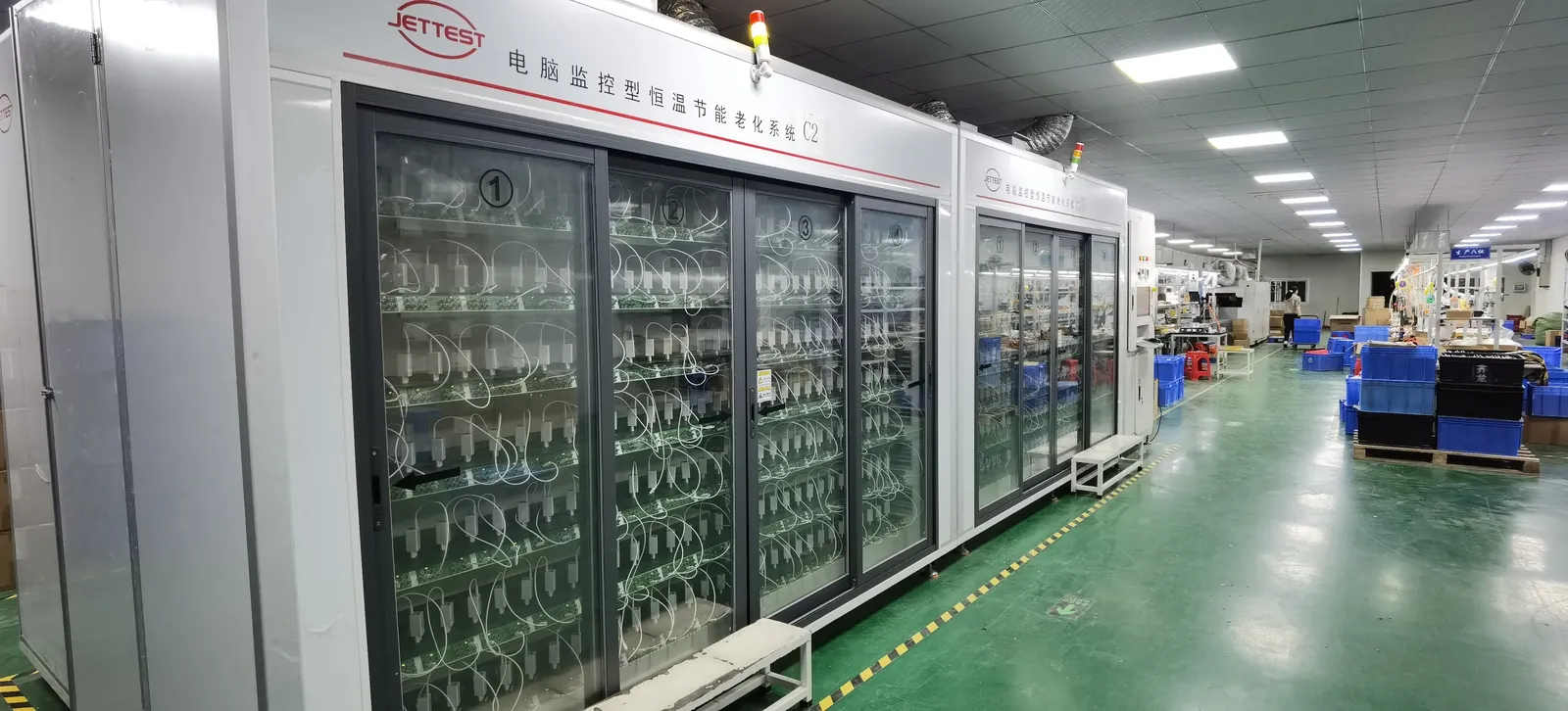
- 100% testing and burn-in. Every unit, not an AQL sample. Our own line runs 100% ATE functional testing and a burn-in period before packing, and boards are built by qualified partner SMT houses with incoming inspection at our factory — assembly, test and aging are in-house.
- Change control in writing. A silent component substitution on a signage platform can re-open certification and change thermal behaviour. The written change-notification process in the OEM agreement guide exists for exactly this.
- Service model. Decide whether the field-replaceable unit is the supply alone or a module; it changes connector choice and packaging.
Ask any supplier to walk you through these on a video call, using the same questions as our sample evaluation checklist.
Certifications and compliance
Signage power sits in the IT and AV regulatory frame, with a commercial-installation twist:
- Safety: IEC/EN 62368-1 is the current hazard-based standard for IT and AV equipment; some constructions are assessed to the IEC 61558 series instead.
- EMC: FCC Part 15 in the US — Class A for commercial environments, Class B for residential. Most signage is Class A, but confirming this early avoids a registration surprise.
- Efficiency: DOE Level VI / EU CoC Tier 2 for external supplies; continuous duty makes this an operating cost, not a formality.
- Regional marks: CE/CB for Europe, UL/cUL or ETL for North America, plus country schemes such as INMETRO in Brazil, BIS in India and others.
We certify per model and per market rather than claiming one certificate covers everything; certification by country explains which schemes transfer cleanly and which need local registration.
Digital signage power specification table
| Parameter | Typical for digital signage | Note |
|---|---|---|
| Output | 12V / 19V (players, small panels); 24V / 48V (LED tiles, walls) | Rail choice sets cable reach |
| Duty cycle | 16–24 h/day, continuous rating required | Not an intermittent-use supply |
| Thermal | Rating at 40–50 °C with derating curve; 105 °C capacitors | Sealed, fanless enclosures |
| Efficiency | DOE VI / CoC Tier 2, with light-load behaviour | Lower loss = less heat = longer life |
| Enclosure (outdoor) | IP65+ and potting where exposed | Solar gain, not just rain |
| Connector | Locking barrel or terminal block for installed units | Vibration and service access |
| Reliability | 100% ATE + burn-in; written change control | Fleets outlive product cycles |
Frequently asked questions
What voltage do digital signage displays use?
Media players and small panels usually run 12V or 19V; LED tiles and larger low-voltage panels use 24V or 48V. Large commercial displays generally take AC mains directly and contain their own supply, so confirm which part of the system you are actually powering before requesting a quote.
Do large commercial displays use an external adapter?
Usually no — most 43″ and larger commercial displays have an internal supply and an IEC mains inlet. The external supply in a signage installation typically powers the media player, a small display, or an LED tile.
How do I size power for a 7×24 signage deployment?
Size for continuous duty at the real enclosure temperature, with a stated derating curve and 20–30% headroom — not for the peak wattage on a benchtop. Then confirm light-load efficiency, because the supply idles for much of the night.
Does brightness change the power requirement?
Yes, roughly in proportion, and outdoor panels can draw several times an indoor screen of the same size. Content matters too: a bright, high-motion loop pulls more than a dark static menu, so size for the worst realistic content.
How do I handle heat in a sealed signage enclosure?
Specify higher efficiency and higher-temperature capacitors, derate more, and keep the supply away from the panel’s hot surface. Cooler operation is the difference between a five-year life and a two-year life.
What about outdoor digital signage power?
Rate for the hottest hour, use IP65 or better with potting where the supply is exposed, and specify UV-resistant cable jackets. Outdoor cabinets carry solar gain on top of their own waste heat, so the thermal margin must be larger than indoor designs.
Which certifications does a signage power supply need?
IEC/EN 62368-1 for safety, FCC Part 15 Class A for commercial environments, CE/CB for Europe, plus DOE Level VI or CoC Tier 2 efficiency and country marks for the destination market. A digital signage power supply OEM should certify per model and market rather than claim one certificate covers all.
What MOQ and lead time apply for custom signage power supplies?
From 200 pcs per model at Paiyi Power, with samples in about a week and first production 5–6 weeks after sample approval. Modified-standard builds usually need no new tooling. Evaluate first samples with our sample evaluation checklist.
Why do signage power supplies fail in summer?
Heat. Enclosures run well above ambient in summer, capacitor life roughly halves for every 10 °C rise, and a supply specified at 25 °C is often a much smaller supply at 55 °C. Specify 105 °C capacitors, a real derating curve, and enough margin for the hottest day rather than the average one.
Sources
- IEC — 62368-1 safety, 60529 IP codes, 61000 EMC series
- FCC — Part 15 rules (Class A / Class B digital devices)
- U.S. DOE — External Power Supply efficiency (Level VI)
- UL — safety certification for IT and AV power equipment
- NIST — measurement and standards references for electrical equipment
Related on this blog: CCTV camera power supply OEM, network equipment power adapter OEM, external power supply efficiency standards, why power adapters fail.